


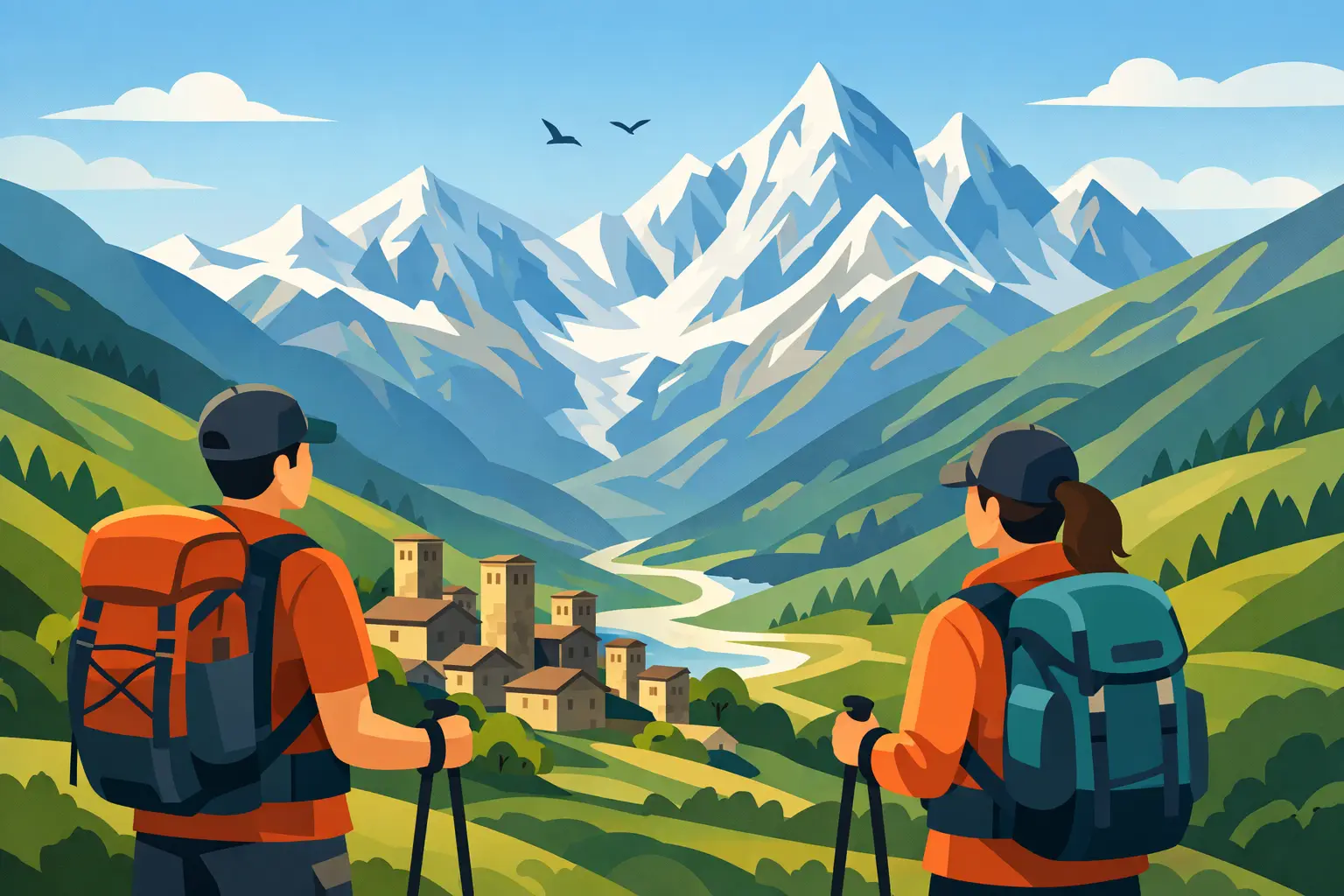
Svaneti does not make a quiet first impression. The road climbs through the Enguri Gorge, mountains close in, and then medieval stone towers begin appearing above green fields and village roofs. Svaneti trekking tours turn this dramatic corner of northwest Georgia into a journey you can experience at walking pace, with the practical support needed for a remote mountain region.
For many visitors, the classic trek from Mestia to Ushguli is the reason to come. But Svaneti has more than one kind of trail. You can choose a village-to-village route with guesthouse stays, a demanding summit-focused hike, or gentler day walks based in Mestia. The best option depends on your fitness, the month you travel, and whether you want long mountain days or time for food, culture, and a glass of local wine after the boots come off.
Why Svaneti Is Made for Trekking
Svaneti sits on the southern slopes of the Greater Caucasus, a region where snow peaks, glaciers, alpine meadows, and ancient villages share the same view. The landscape feels genuinely remote, yet the main trekking routes connect established communities rather than isolated campsites. That is a rare combination: you can spend the day crossing high passes and finish it with a hot meal in a family-run guesthouse.
The region is also deeply cultural. The defensive towers of Upper Svaneti, especially around Ushguli, are not scenery built for tourists. They are part of a living mountain heritage shaped by geography, family history, and centuries of self-reliance. A guided trek adds context to what you see, from small village churches to the traditions behind Svan cuisine.
For travelers coming from the United States, Canada, the UK, Australia, or Western Europe, Svaneti can feel far more adventurous than a standard Alpine vacation. Trails are not as heavily built up, signage can be limited, and weather changes quickly. That is precisely why a well-organized trek matters. The reward is a mountain experience that still feels personal and uncrowded.
The Classic Mestia to Ushguli Trek
The most famous of all Svaneti trekking tours is the four-day route from Mestia to Ushguli. It is a point-to-point trek, usually covering roughly 30 to 35 miles across valleys, forest tracks, open slopes, and high passes. Each day has its own character, and the route works especially well for travelers who want a complete mountain journey without carrying camping equipment.
The trail normally begins in Mestia, the regional center and a useful place to rest, arrange gear, and visit the Svaneti Museum of History and Ethnography before departure. From there, walkers move through villages such as Zhabiani, Adishi, Iprali, and Kala before reaching Ushguli, one of Europe’s highest permanently inhabited settlements.
The Adishi Glacier area is often the visual high point, while the Chkhunderi Pass provides the trek’s grandest panorama. On a clear day, the views extend across glacier valleys and toward the great wall of the Caucasus. The final arrival in Ushguli, beneath the presence of Mount Shkhara, is equally memorable. Stone towers, grazing horses, and snow-covered peaks make the village feel like a place from another century.
This route is moderately challenging rather than technical in normal summer conditions. Expect daily walking times of around five to seven hours, with sustained climbs and descents. Fitness matters more than speed. Travelers who hike regularly and are comfortable on uneven ground usually enjoy it most, especially when they allow an extra day in Mestia before or after the trek.
River Crossings and Route Conditions
The Adishi River crossing is one practical detail that deserves attention. Water levels can rise during the day, particularly early in the season, and local horse assistance may be used when conditions require it. A responsible guide will assess the crossing rather than treat it as a fixed part of the itinerary.
Trail conditions also change from year to year. Mud after rain, snow patches on high ground in early summer, and occasional road or trail repairs can affect daily plans. Flexibility is not a compromise in Svaneti. It is good mountain travel.
Other Trekking Routes Worth Considering
The Mestia to Ushguli trail is a standout, but it is not the only choice. Travelers with limited time can use Mestia as a base for rewarding day hikes. The walk to Chalaadi Glacier is a popular option with a shorter time commitment, while the trail toward Koruldi Lakes offers broad views of Mestia and the surrounding summits. These hikes are ideal for families with active teens, first-time visitors to Georgia, or anyone building a wider itinerary that includes Tbilisi, Kakheti, Kutaisi, or Kazbegi.
For stronger hikers, the route toward Mazeri and the Ushba waterfalls brings you close to one of the Caucasus’ most striking peaks. Mount Ushba is famous for its sharp twin summits and serious climbing reputation. You do not need to be a climber to appreciate it, but the terrain around Mazeri can involve longer, steeper days.
Experienced trekkers may also consider longer routes that connect Svaneti with neighboring mountain regions. These journeys demand more planning, stronger navigation, and a realistic understanding of changing weather and transport access. They are best arranged with a local operator that can coordinate guides, transfers, accommodations, and contingency plans.
When to Go Trekking in Svaneti
For most hikers, late June through September is the practical trekking season. July and August generally offer the most reliable access to high trails, warmer temperatures, and full guesthouse availability. They are also the busiest months, although Svaneti remains far quieter than many major European hiking destinations.
June can be beautiful, with fresh green valleys and powerful rivers, but snow may still linger on high passes. September brings golden grass, clearer mountain light, and cooler evenings. It is an excellent choice for hikers who prefer fewer people on the trail and do not mind packing warmer layers.
October is more uncertain. Lower hikes may still be possible, but early snow can close or complicate higher routes. Winter transforms Svaneti into a skiing and snowshoeing destination rather than a standard trekking region. If your heart is set on the Mestia to Ushguli route, summer and early fall are the sensible choices.
What a Guided Trek Solves
Independent hiking is possible for confident travelers, but guided travel makes the experience much easier to enjoy. In Svaneti, logistics are part of the adventure. Transport between Kutaisi or Tbilisi and Mestia, guesthouse reservations, luggage transfers, trail updates, and weather decisions all need coordination.
A local guide also brings cultural access that no map can provide. They can explain village customs, help communicate with hosts, identify the peaks in front of you, and adjust the route when a river crossing or mountain forecast calls for a change. This is especially valuable for solo travelers and groups who want the freedom of the trail without the burden of managing every detail.
Colour Tour Georgia can organize Svaneti programs around different travel styles, from active multi-day treks to broader Georgia itineraries that combine hiking with culture, food, wine, and comfortable transfers. The right itinerary should match your walking ability rather than ask you to fit a one-size-fits-all schedule.
Packing for the Caucasus
Bring proven hiking boots with good grip, a waterproof jacket, a warm insulating layer, sun protection, and a small daypack. Even in August, a high pass can feel cold when clouds move in. Trekking poles are useful for long descents and slippery sections, while a refillable water bottle and basic blister care are small items with a big impact.
Pack lighter than you think. On a supported trek, your main luggage can often be transferred between overnight stops, leaving you to carry water, layers, snacks, and personal essentials. Guesthouses are welcoming but simple in some villages, so a compact power bank, headlamp, and a little patience are worthwhile companions.
The strongest Svaneti trips leave room for the unexpected: a longer tea stop with a host family, a morning when clouds part over Ushba, or an extra night in Mestia because the mountains have convinced you not to rush away.