


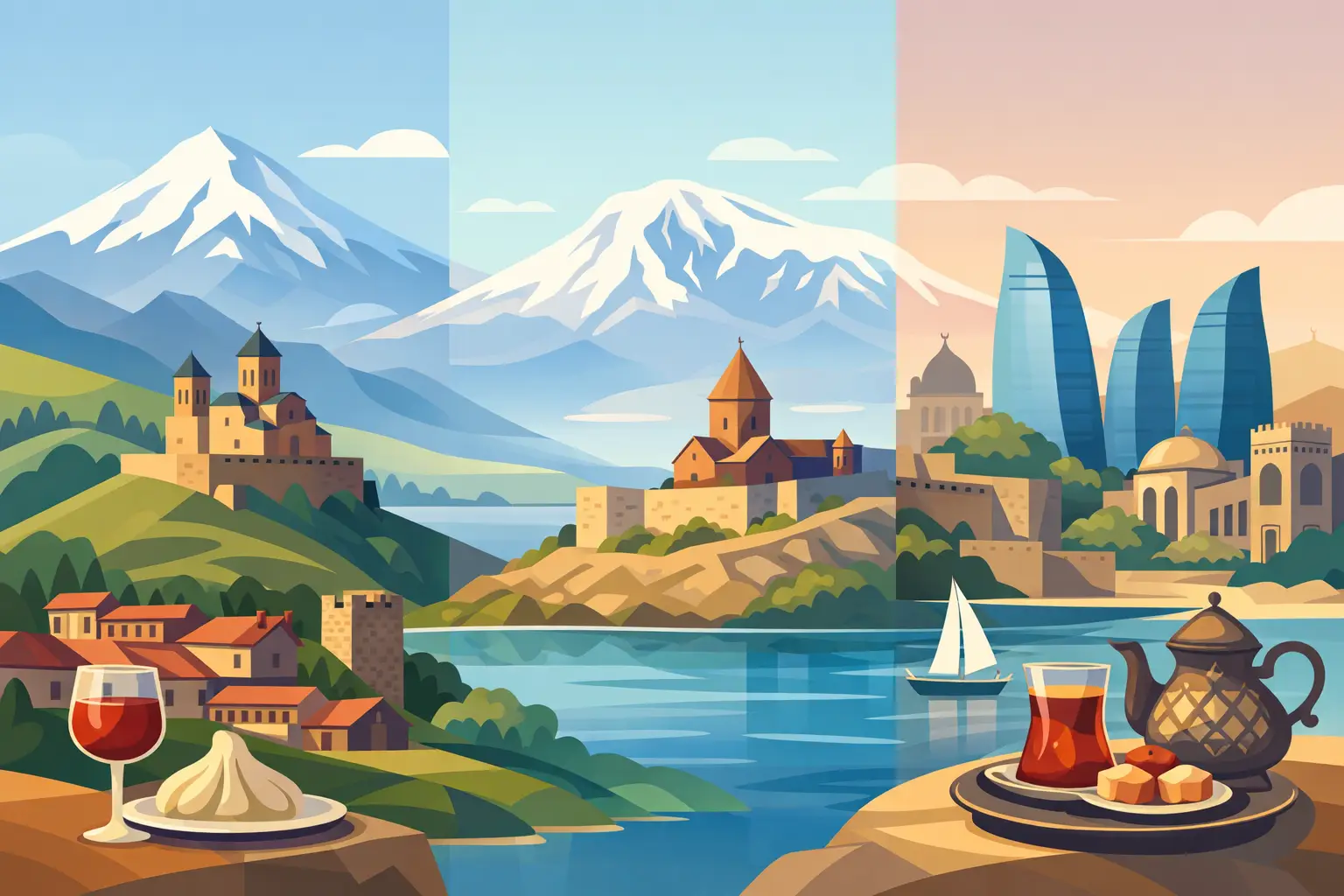
A sulfur bath beneath Tbilisi’s old brick domes, a glass of amber wine in Kakheti, a monastery above Lake Sevan, and Baku’s illuminated waterfront can all belong to one remarkable journey. Georgia Armenia Azerbaijan tours bring together three neighboring countries with very different rhythms: Georgia’s mountain hospitality and wine culture, Armenia’s stone-carved Christian heritage, and Azerbaijan’s Caspian energy, modern architecture, and Silk Road history.
This is not a trip to rush. The South Caucasus rewards travelers who leave room for long lunches, winding mountain roads, local stories, and those unplanned stops when a view demands a photograph. With the right route and reliable local logistics, it is also far easier to experience than its dramatic map may suggest.
Why Georgia Armenia Azerbaijan Tours Feel So Rich
The distance between major cities is relatively compact, but the cultural contrast is striking. In Georgia, Tbilisi combines balconies, Orthodox churches, contemporary wine bars, and lively markets in one walkable capital. Beyond the city, Kakheti offers family wine cellars and broad vineyard valleys, while Kazbegi, Svaneti, and Vardzia reveal entirely different landscapes and histories.
Armenia feels intimate and deeply rooted. Yerevan is built in warm pink tuff stone, with café life and museums set against the frequent silhouette of Mount Ararat. Outside the capital, medieval monasteries are not simply museum pieces. They sit in gorges, on high plateaus, and beside lakes, giving even a short cultural stop a powerful sense of place.
Azerbaijan introduces another layer. Baku pairs a walled old city with bold contemporary buildings and a sweeping Caspian promenade. A journey outside the capital may include rock art, mud volcanoes, fire temples, mountain villages, or the old Silk Road atmosphere of Sheki. The food changes, too: expect aromatic rice dishes, grilled meats, herbs, saffron, and tea served with sweets and preserves.
Together, the countries make sense as a single regional journey because each adds contrast. Yet they should not be treated as interchangeable stops. Their languages, histories, cuisines, religious traditions, and landscapes are distinct. A good itinerary gives every country enough time to speak in its own voice.
Choose a Route That Respects the Map
For most first-time visitors, Georgia works beautifully as the starting point. Tbilisi has strong international air connections, a wide choice of hotels, and easy access to eastern Georgia and Armenia. A classic route begins with several days in Tbilisi and Kakheti, continues to Yerevan and Armenia’s heritage sites, then returns to Tbilisi before flying to Baku if current flight schedules and entry rules support that plan.
The key planning point is the Armenia-Azerbaijan border. It is closed to regular tourist travel, so travelers cannot expect to drive directly from Yerevan to Baku or cross overland between the two countries. Georgia is the natural geographical link, but border regulations, flight schedules, and land-entry policies can change. Confirm the current requirements with your tour operator and the relevant authorities before booking nonrefundable flights.
This is where an organized itinerary earns its value. Rather than losing a day to uncertain connections or trying to coordinate separate drivers, hotels, guides, and border transfers, travelers can follow a route designed around what is actually possible at the time of travel. Colour Tour Georgia can arrange cross-border programs with the practical pieces considered as one journey.
How Much Time Is Enough?
Ten days is the minimum for a satisfying introduction, especially if the itinerary focuses on Tbilisi, Yerevan, and Baku with a few essential day trips. It will feel active, and mountain regions may need to wait for another visit.
Two weeks is the sweet spot for many travelers. It allows time for Tbilisi’s old town, Mtskheta, Kakheti wine country, Armenia’s Garni, Geghard, Lake Sevan, and Dilijan area, plus Baku and one or two Azerbaijan excursions. You can travel at a comfortable pace without reducing every destination to a hotel check-in and a photo stop.
If trekking in Svaneti, an off-road route in Tusheti, several wine experiences, or a deeper Azerbaijan mountain program is a priority, allow 16 to 21 days. The region is compact on a world map, but roads in the Caucasus can be slow, scenic, and occasionally weather-dependent.
What a Well-Balanced Itinerary Includes
A strong three-country itinerary blends capitals with countryside. Tbilisi, Yerevan, and Baku each deserve overnight stays, not just airport arrivals. Their restaurants, evening walks, museums, and neighborhoods tell a different story after daylight fades.
In Georgia, add at least one landscape-focused portion. Kazbegi suits travelers who want high alpine scenery and the famous Gergeti Trinity Church. Kakheti is ideal for food and wine lovers, with qvevri wine traditions, market produce, and historic towns such as Sighnaghi. For more time and a higher adventure level, Svaneti offers medieval towers and serious mountain views.
In Armenia, Garni Temple and Geghard Monastery make a rewarding pairing, while Lake Sevan brings open horizons and a welcome break from city streets. Travelers interested in medieval architecture may prefer a route toward Tatev or the monasteries of northern Armenia. The best choice depends on whether your group values road-trip scenery, spiritual heritage, hiking, or more relaxed cultural touring.
In Azerbaijan, Baku’s Old City should be combined with a day beyond the capital. Gobustan is a popular choice for ancient rock carvings and unusual geological landscapes. Sheki is better for travelers who can spare extra time and want historic caravanserai atmosphere, crafts, and foothill scenery. The contrast between Baku’s futuristic skyline and Azerbaijan’s rural regions is part of the experience.
Food and Wine Are Part of the Route
Do not plan your meals as an afterthought. In the South Caucasus, a table is often where a destination becomes personal. Georgia is celebrated for khachapuri, khinkali, grilled meats, vegetable dishes with walnuts, and wines made in clay qvevri vessels. A traditional feast can be generous and lively, often led by toasts that carry history, humor, and friendship.
Armenian meals bring lavash, fresh herbs, grilled meats, cheeses, dolma, and apricots in many forms. Brandy and wine tastings can add interest, but a simple meal in a family restaurant may be just as memorable. Azerbaijan offers plov, kebabs, soups, fresh bread, black tea, and fragrant desserts. Vegetarian travelers can eat well across the region, although communicating preferences in advance is wise, particularly in smaller towns.
Wine lovers should give Georgia extra days rather than trying to fit a cellar visit into a rushed transit afternoon. Kakheti is not only about tasting. It is about meeting winemakers, seeing the vineyards, understanding qvevri production, and sitting down to a meal made for the wine in front of you.
When to Travel and What to Expect
May, June, September, and October are excellent for many cultural itineraries. Spring brings green valleys and comfortable city temperatures, while early fall combines harvest energy in Georgia with clear days in much of the region. September is particularly attractive for wine-focused travel, though popular places may be busier.
July and August are well suited to higher mountain areas such as Kazbegi and Svaneti, but Tbilisi, Yerevan, and Baku can be hot. Winter works for city breaks, food, museums, and seasonal celebrations, while Georgia also offers skiing and snowshoeing in its mountain resorts. It is less suitable for a broad highland itinerary, since remote roads and passes may be affected by snow.
Pack layers in every season. A capital-city afternoon can feel warm while a monastery overlook or mountain pass is windy and cool. Comfortable walking shoes matter more than formal footwear, since old towns, archaeological sites, and hillside monasteries often involve uneven ground.
Practical Details That Make the Trip Easier
Use a local guide for more than navigation. The best guides provide context at a monastery, help a market visit feel welcoming rather than confusing, and know when a mountain road or border transfer needs flexibility. Private tours offer the most control over pace and hotel level, while small groups can be a sociable, cost-conscious choice.
Visa and entry requirements depend on your passport and can change, particularly for Azerbaijan. Check current rules before departure and make sure your passport has adequate validity. Travel insurance is strongly recommended, especially when your plans include mountain drives, hiking, or several independent transport connections.
Keep your itinerary realistic. A traveler who wants wine cellars, mountain hikes, monasteries, museums, and three capital cities in eight days will spend too much time in transit. Choose your priorities early. For some, that means a classic cultural route. For others, it means fewer cities and more days among Georgia’s mountains.
The lasting pleasure of this journey is not ticking off three countries. It is standing at a Georgian table as a toast begins, hearing church bells carry over an Armenian valley, or watching Baku’s lights come alive beside the Caspian. Give those moments time, and the South Caucasus will stay with you long after the flight home.