


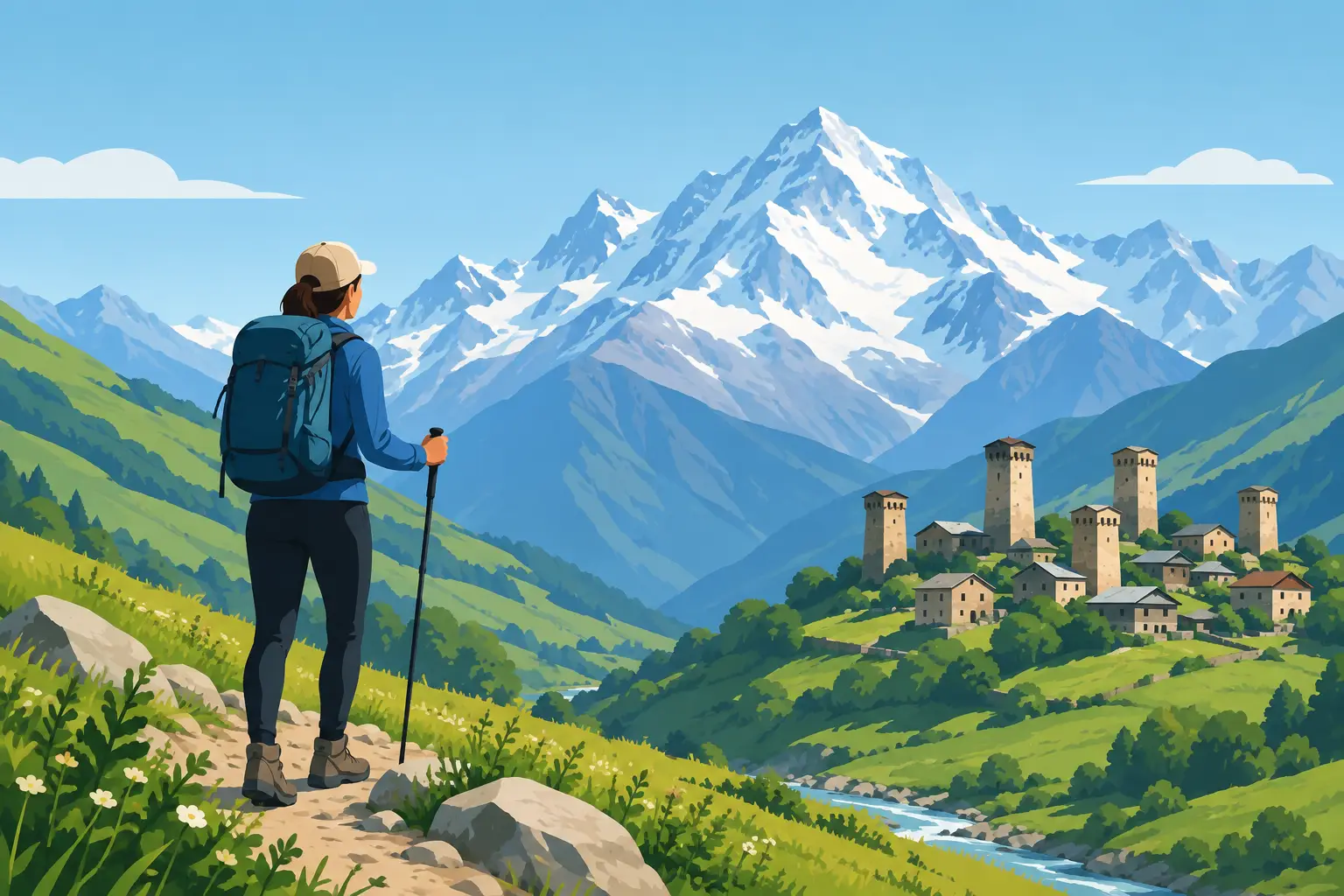
Svaneti does not make a quiet first impression. From Mestia, snow-streaked peaks rise above stone villages and medieval defensive towers, inviting travelers to walk farther than they planned. So, can beginners hike Svaneti? Yes, provided they choose the right walks, allow time to adjust to the altitude, and treat mountain weather and transport logistics with respect.
This is not a destination where every marked-looking path is an easy afternoon stroll. Svaneti is high, remote, and wonderfully dramatic. Yet it also has short valley walks, guided day hikes, village-to-village outings, and comfortable bases in Mestia that make the region accessible to travelers who are new to hiking but eager for a real Caucasus experience.
The honest answer: beginners can hike Svaneti
A beginner does not need technical climbing skills to enjoy Svaneti. You will not need ropes, crampons, or mountaineering experience for the region’s standard summer hiking routes. What you do need is reasonable mobility, sturdy footwear, patience on uneven ground, and a realistic understanding of your own fitness.
The key distinction is between a day hike and the classic Mestia to Ushguli trek. A scenic walk from a village can be suitable for a first-time hiker. The full multi-day route between Mestia and Ushguli is more demanding. It involves consecutive walking days, long climbs and descents, variable trail conditions, and the need to manage weather, meals, accommodation, and luggage. Active beginners can complete it with preparation and support, but it should not be treated as an effortless vacation walk.
Svaneti rewards people who travel at their own pace. A couple who enjoys long city walks and occasional local trails may be perfectly happy on a guided half-day or full-day hike. Someone who rarely exercises may enjoy Svaneti more through scenic drives, village visits, cable-car views, and one carefully selected short walk rather than a strenuous trekking program.
What makes hiking in Svaneti challenging?
The challenge is rarely just the distance. Altitude, terrain, weather, and remoteness all shape the day.
Altitude and uphill walking
Mestia sits at roughly 4,900 feet, while many viewpoints and trail passes rise much higher. Visitors arriving from Tbilisi or Kutaisi can feel breathless on their first uphill climb, even if they are generally fit at home. Spend the first day settling in, walking gently around Mestia, drinking water, and sleeping well before attempting a bigger route.
Steep ascents are common. A hike may look short on a map but still demand sustained effort over loose stones, forest roots, or grassy slopes. Walking poles can make descents kinder on knees and give less experienced hikers more balance.
Mountain weather and trail conditions
A bright morning can turn into rain, fog, or cold wind by afternoon. In early summer, melting snow can affect crossings and make high routes inaccessible. In fall, temperatures can drop quickly, especially after sunset. Fog can erase the views and make route-finding much harder.
That is why beginners should start early, carry a waterproof outer layer, and avoid committing to unfamiliar high terrain late in the day. A local guide is especially valuable when conditions change or when a trail is unclear.
Long transfers and limited infrastructure
Svaneti feels remote because it is remote. Reaching Mestia takes time, and road conditions, seasonal weather, and schedules can affect plans. Once in the mountains, not every village has a store, pharmacy, ATM, or dependable transportation option around the corner.
This is part of Svaneti’s magic, but it favors travelers who plan ahead. Keep water and snacks with you, bring any personal medication, and leave enough flexibility in your itinerary for weather-related adjustments.
Beginner-friendly hikes in Svaneti
The best first hikes focus on valley scenery, waterfalls, villages, and glacier views rather than high passes. Exact times and conditions vary, so treat all estimates as flexible rather than as a race against the clock.
Chalaadi Glacier from Mestia
The walk toward Chalaadi Glacier is one of the most popular introductions to Svaneti’s landscapes. It combines a forest track, river scenery, and an extraordinary view of a glacier beneath towering peaks. Depending on vehicle access and the chosen starting point, it can work as a manageable half-day outing for beginners with decent walking shoes.
The final approach is rocky, and conditions near the glacier can be cold even on a warm day. Do not walk onto the ice or venture beyond safe, established areas. The goal is the view, not getting as close as possible to a changing glacier.
Mazeri Valley and waterfall walks
Mazeri, west of Mestia, is a beautiful choice for travelers who prefer green valleys and waterfalls to a big summit-style challenge. Several walks begin near the village, with views toward Mount Ushba, one of the Caucasus’s most striking peaks.
Some waterfall routes are gentler than others, and a guide or driver can help select an option that matches the group’s energy level. This is an excellent area for families with active older children, couples, and first-time hikers who want a full mountain day without committing to a high-altitude pass.
Ushguli and the Shkhara Valley
Ushguli is famous for its stone towers, high mountain setting, and remarkable position beneath the Caucasus range. From the village, the route toward the Shkhara Glacier follows a broad valley and is often approached as a scenic out-and-back walk. It is not completely flat, and altitude is noticeable, but the terrain is generally less intimidating than a steep mountain ascent.
Because Ushguli is high and weather can be severe, this is best planned in stable conditions. A vehicle transfer can shorten the walking distance for beginners who want the landscape and glacier views without an overly long day.
Routes to save for another trip
Koruldi Lakes, high passes, and the complete Mestia-to-Ushguli crossing are magnificent, but they are not the natural first choice for every beginner. Koruldi involves a substantial ascent at altitude. The multi-day trek requires stamina and confidence over several days, even when luggage transfers are arranged.
That does not mean these routes are off-limits forever. They are excellent goals after building fitness or for active newcomers traveling with an experienced guide and a deliberately paced itinerary.
Can beginners hike Svaneti independently?
Independent hiking is possible on well-known routes near Mestia, particularly for travelers who are comfortable reading offline maps, monitoring forecasts, and turning back when conditions are not right. However, self-guided does not automatically mean simpler or cheaper once transport, route uncertainty, and last-minute changes are considered.
For beginners, a guided day hike offers more than navigation. A local guide can choose a route suited to the weather and the group’s ability, arrange transfers to trailheads, explain village traditions, and recognize when a plan needs to change. That turns a potentially stressful day into a relaxed encounter with Svaneti’s glaciers, towers, and mountain hospitality.
For travelers combining hiking with culture, a Svaneti program through Colour Tour Georgia can pair manageable walks with Mestia sightseeing, local meals, accommodation, and the transport that makes this remote region easier to enjoy. It is a practical choice for visitors who want adventure without spending their vacation solving every logistical detail.
How to prepare for your first Svaneti hike
You do not need to train like an endurance athlete, but preparation changes the experience. In the month before travel, take regular brisk walks and include hills, stairs, or a treadmill incline when possible. Build up to being comfortable on your feet for four to six hours with breaks. If you have knee, heart, or respiratory concerns, speak with a medical professional before planning demanding elevation gain.
Bring broken-in hiking shoes or trail shoes with grip, not brand-new boots. Pack layers rather than one heavy item: a breathable shirt, warm mid-layer, rain jacket, hat, and sunscreen can all be useful on the same day. A small daypack should hold water, snacks, personal medication, a charged phone, and an offline map. Add walking poles if you are uncertain on descents.
Most importantly, do not let a published route time pressure you. Stop for water, photographs, and the occasional khachapuri picnic. The mountains will still be there if you choose the shorter option.
The best time for beginners to hike Svaneti
For most visitors, late June through September is the most practical hiking season. Summer brings the broadest access to trails, warmer days, and long daylight hours, though afternoon storms remain possible. July and August are the busiest months, especially in Mestia and Ushguli.
September often offers crisp air, golden slopes, and fewer visitors, but weather becomes less predictable as the month progresses. Early June can be lovely in the valleys, while high trails may still hold snow. October is better approached with flexibility and a plan centered on lower walks, culture, and scenic drives rather than high trekking routes.
Winter transforms Svaneti into a snow destination, with skiing and snowshoeing opportunities around Mestia. It is not the season for a beginner to attempt summer hiking itineraries independently.
A first hike in Svaneti should leave you with energy to sit beneath a tower at dinner, taste local kubdari pie, and watch the evening light move across the peaks. Choose the walk that gives you that day, not the one that gives you the biggest number on an elevation chart.