


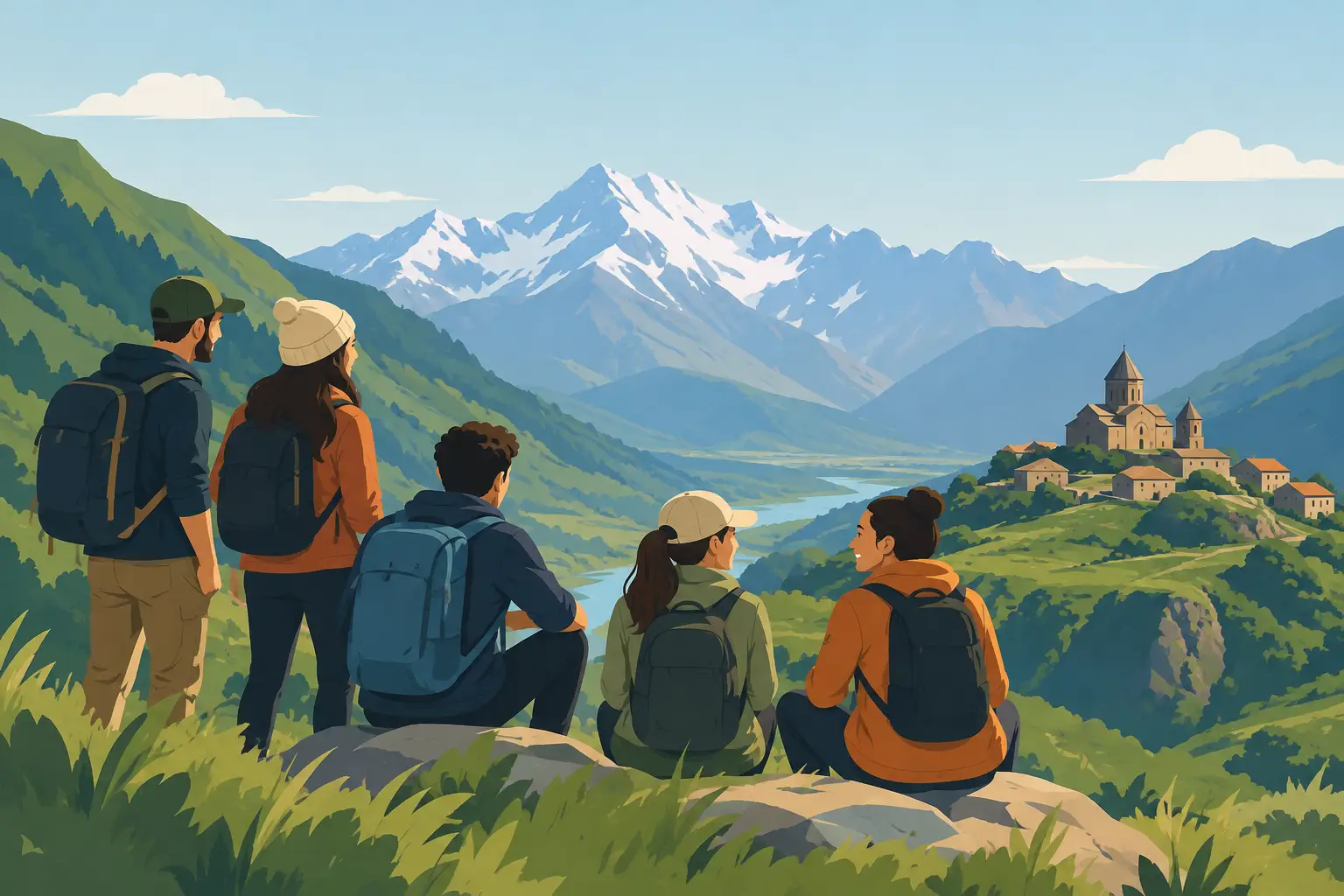
A long table in Kakheti, a winding road below Mount Kazbegi, a medieval tower rising above Svaneti: these moments are richer when they are shared. Caucasus group travel brings friends, families, clubs, and special-interest travelers into a region where one day can hold a city walk, a monastery visit, a home-cooked lunch, and a mountain view that silences the whole vehicle.
Georgia, Armenia, and Azerbaijan are close on the map but remarkably varied in character. For a group, that variety is the attraction and the planning challenge. Roads change from smooth highways to mountain tracks, hotel styles differ by region, and the best experience often depends on arriving at the right time with the right guide. A well-built group program turns those moving parts into a trip that feels generous rather than rushed.
Why the Caucasus Works So Well for Groups
The South Caucasus rewards travelers who want more than a checklist of landmarks. Georgia offers ancient churches, lively Tbilisi neighborhoods, amber wine in clay vessels, dramatic highland villages, and a food culture made for passing plates around the table. Armenia adds stone monasteries, deep spiritual heritage, and highland landscapes. Azerbaijan brings a different rhythm, with Baku’s modern skyline, old-city walls, and routes reaching into the Caucasus foothills.
For groups, the region has a rare social energy. A traditional Georgian supra, or feast, is not simply dinner. It is an occasion of toasts, stories, dishes arriving in succession, and genuine hospitality. Wine tastings in family cellars feel more memorable when everyone compares a favorite qvevri wine. A hike to Gergeti Trinity Church can be adapted for active walkers while others enjoy the same mountain setting from a scenic stop nearby.
It is also a destination where a local guide changes the experience. The landscape is spectacular on its own, but context gives it depth: why a monastery was built on that ridge, how tower villages defended their communities, or why a particular cheese appears on the table in one region and not another.
Start With the Group, Not the Map
The strongest Caucasus group travel itineraries begin with a candid look at who is traveling. A group of friends in their thirties may want hiking days, late dinners, and wine-country stays. A multigenerational family may prefer shorter drives, comfortable hotels, and a mix of guided visits with unstructured afternoons. A faith-based group may put Mtskheta, David Gareja, Vardzia, and Armenian monasteries at the center of the route.
Physical ability matters, especially in the mountains. A drive into Svaneti or Kazbegi is accessible to many travelers, while a multi-day trek from Tusheti toward Khevsureti requires sound fitness, appropriate gear, and flexibility around weather. There is no single “best” itinerary. The right one gives the group a shared experience without asking every traveler to enjoy the destination in exactly the same way.
Before choosing destinations, decide what should define the trip. Is it food and wine? Christian heritage? hiking? photography? cycling? winter scenery? That decision helps determine whether to spend more time in Kakheti, add the Georgian Military Highway, travel west to Kutaisi and Batumi, or build a cross-border route through Armenia and Azerbaijan.
A sensible pace makes the difference
Georgia may look compact, but mountain roads make distances feel longer than they appear. A group can travel from Tbilisi to Kazbegi in a day, yet the route deserves stops at Ananuri Fortress, the Jinvali Reservoir, and viewpoints along the Georgian Military Highway. Treating it as a transfer means missing much of the experience.
For most first-time groups, seven to 10 days in Georgia allows for Tbilisi, Mtskheta, Kazbegi, Kakheti, and either Svaneti or western Georgia. Two weeks opens the door to a fuller circuit, with time for Vardzia, Kutaisi, Batumi, or a cross-border extension. Building in one slower day is not wasted time. It gives travelers room to browse Tbilisi, enjoy a spa visit, linger over lunch, or recover before the next mountain road.
Choose Experiences That Bring People Together
A group itinerary needs anchor moments: experiences everyone will remember and talk about later. In Georgia, those are often surprisingly simple. A khachapuri-making class, a cellar lunch in Kakheti, a walk through Tbilisi’s old town, or an evening of folk music can connect a group more naturally than an overpacked schedule.
Cultural travelers may combine Tbilisi, Mtskheta, Uplistsikhe, Gori, and Vardzia with wine country in Kakheti. Active groups can pair Kazbegi with hiking in Svaneti, cycling in quieter valleys, or off-road access into Tusheti when seasonal conditions allow. Winter groups can focus on Gudauri skiing and snowshoeing, then return to Tbilisi for restaurants, sulfur baths, and city life.
The trade-off is simple: more regions create a broader picture of the Caucasus, while fewer bases create a calmer and deeper journey. A group that stays two or three nights in Svaneti can absorb the atmosphere of Mestia and Ushguli. A group that spends only one night may collect impressive photos but leave before the place has time to settle in.
Make room for individual interests
Shared travel does not require every hour to be shared. On a Tbilisi afternoon, some guests may want museums and architecture while others prefer cafés, markets, or a walk through Sololaki. In Kakheti, one part of the group may be eager for a formal wine tasting, while another may value a relaxed vineyard lunch and views over the Alazani Valley.
This is where clear daily planning helps. Identify the experiences that are essential for everyone, then create optional free time in places where travelers can safely and easily explore. It keeps the group connected without making the trip feel managed down to the minute.
The Logistics Behind a Relaxed Group Trip
A memorable Caucasus journey needs reliable practical support. Vehicle size should match both the number of guests and the terrain. A comfortable coach works well for city-to-city cultural routes, while remote mountain roads may call for smaller vehicles or 4×4 transport. Luggage capacity matters more than travelers expect, particularly when a group includes hiking equipment or winter gear.
Accommodation should follow the personality of the itinerary. In Tbilisi, a central hotel makes evenings easy and gives guests freedom. In rural regions, family-run guesthouses can offer warmth and local character, though room layouts and facilities may be more varied than in a city hotel. For premium groups, carefully selected boutique hotels and high-quality wine estates can elevate the journey without losing its sense of place.
Meals deserve the same attention as sightseeing. Georgian portions are generous, and dietary needs should be collected well before arrival. Vegetarian, vegan, gluten-free, and other special requests can often be accommodated, but remote areas have fewer options than Tbilisi. Good advance planning protects both comfort and the pleasure of trying local dishes.
Travel documents and border arrangements need early review for any Armenia or Azerbaijan extension. Requirements vary by passport, and group timing at a border can be less predictable than a domestic drive. Cross-border programs are rewarding, but they work best when the itinerary has breathing room rather than a tightly scheduled arrival evening.
When to Travel With a Group
May, June, September, and October are often excellent months for a wide-ranging Caucasus itinerary. Valleys are green in spring, wine country is lively in fall, and temperatures are generally comfortable for touring. September and October are particularly appealing for harvest-season food and wine experiences in Kakheti.
July and August suit high-altitude hiking in Svaneti, Tusheti, and Kazbegi, but Tbilisi and lower elevations can be hot. Winter has its own appeal for skiing, snowshoeing, festive city breaks, and quiet monastery visits, although mountain weather can affect road conditions. If the group has one non-negotiable activity, such as trekking or skiing, let that season lead the planning.
A Local Partner Gives Groups More Freedom
For an organizer, the goal is not to control every detail. It is to give travelers confidence that the details have been handled. That means realistic driving times, guides who can read the mood of the group, restaurants prepared for arrivals, and a plan B when weather changes in the mountains.
Colour Tour Georgia can shape group journeys around cultural touring, wine, outdoor adventure, pilgrimage, and cross-border travel, while coordinating the practical pieces from airport transfers to accommodations. For travel advisors and group leaders, that local coordination creates room to focus on the people traveling with them.
The Caucasus is at its best when a group has time to be surprised: by a toast from a host, a road opening onto a snowy peak, or a village meal that lasts longer than planned. Leave room for those moments. They are often the part of the journey that travelers carry home.