


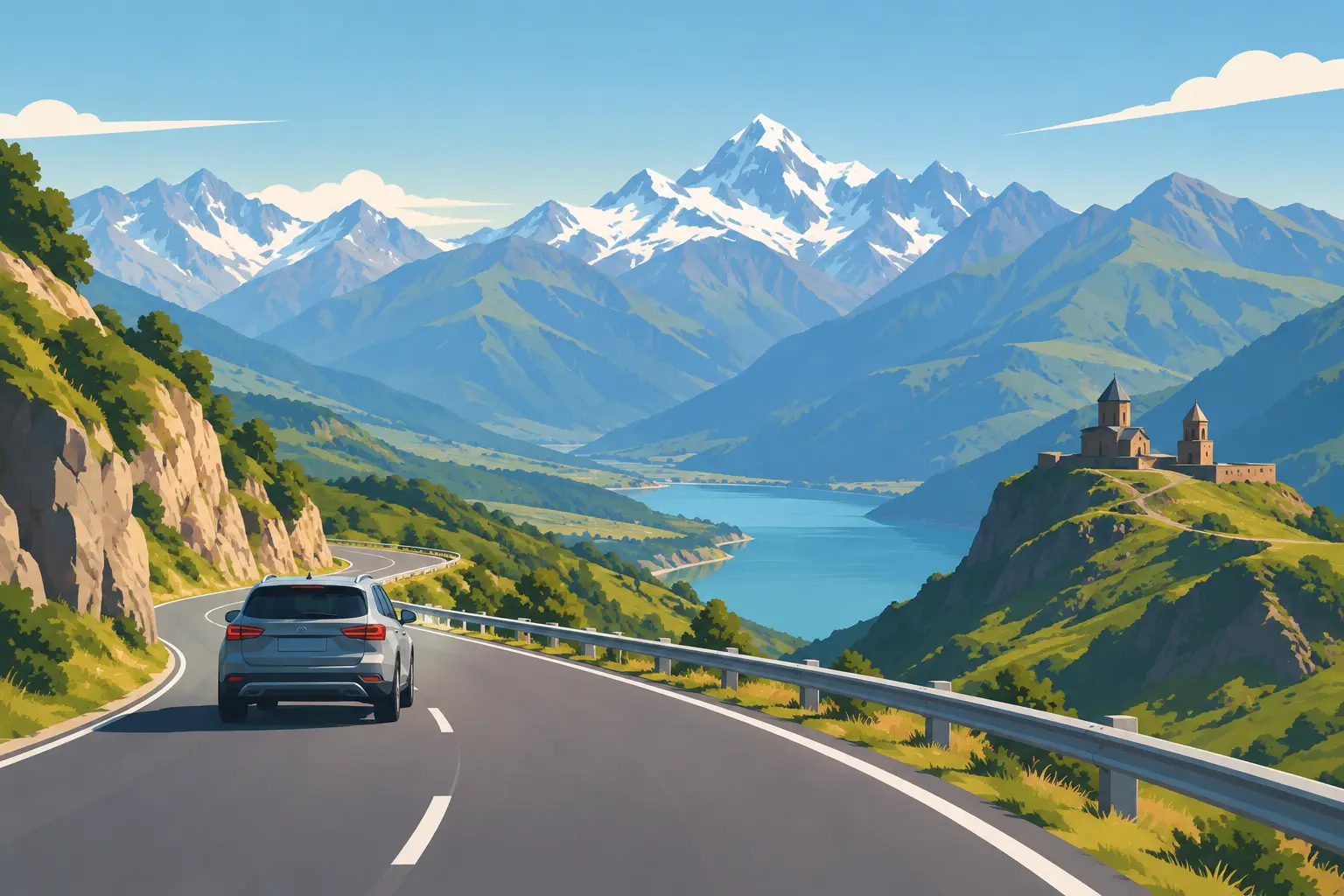
The best Caucasus road trips are not about racing from one capital to the next. They are about stopping when a medieval tower rises above a river valley, taking the long way to a family wine cellar, and realizing that the road ahead is climbing into mountains that still feel beautifully remote. Georgia makes an especially rewarding base: distances are manageable, landscapes change fast, and a warm meal is rarely far away.
For first-time visitors, a private driver-guide or organized multi-day tour often offers more freedom than a self-drive rental. Mountain roads, changing weather, livestock on the pavement, and cross-border rental rules can make logistics more involved than the map suggests. But choose the right route and leave room for detours, and the Caucasus delivers a road journey with real color.
1. Tbilisi to Kazbegi via the Georgian Military Highway
This is the classic introduction to Georgian mountain scenery and one of the most accessible drives from Tbilisi. The road follows the Aragvi Valley north through Ananuri, where the stone fortress and church complex sit above the turquoise Jinvali Reservoir. From there, the views become bigger with every switchback.
The route reaches Gudauri, Georgia’s main ski resort, before crossing the Jvari Pass and descending toward Stepantsminda, often called Kazbegi. The prize is the view of Gergeti Trinity Church beneath Mount Kazbek, a summit that dominates the valley on clear days. A 4WD vehicle is useful for the final climb to the church, although local transfers are commonly available.
Plan a full day from Tbilisi, or better yet, stay overnight in Stepantsminda. An overnight gives you a chance to see the mountains in early morning light, walk in the Sno Valley, or continue toward the dramatic Dariali Gorge. This is a good route for couples, families, and travelers who want major scenery without committing to rugged off-road travel.
2. Kakheti’s Wine Roads from Tbilisi to Sighnaghi
Kakheti proves that a road trip can be as much about a table as a landscape. East of Tbilisi, the terrain opens into vineyards, orchards, and wide views toward the Greater Caucasus. The region is the heartland of Georgia’s ancient qvevri winemaking tradition, where wine ferments and ages in clay vessels buried underground.
A satisfying route runs from Tbilisi through the Gombori Pass or via the David Gareja side of the region, then into Telavi, Tsinandali, Kvareli, and Sighnaghi. Each direction creates a different journey. Telavi and Kvareli are ideal for cellar visits and larger estates, while Sighnaghi brings cobbled lanes, old walls, and a romantic view over the Alazani Valley.
Do not try to pack too many tastings into one driving day. Georgian hospitality is generous, and a proper lunch with wine, cheese, bread, grilled meats, and seasonal dishes deserves time. A driver-guide is the sensible choice if wine is central to the plan. Two or three nights allow room for wineries, Gremi Fortress, Alaverdi Cathedral, local markets, and slow village meals.
3. Kutaisi to Mestia: The Road into Svaneti
The drive from Kutaisi to Mestia is one of Georgia’s grandest transitions. Start in the green lowlands of Imereti, pass through Zugdidi, then follow the Enguri River as the road narrows into a spectacular mountain corridor. Hydroelectric reservoirs, forested slopes, waterfalls, and sheer rock faces set the stage before Upper Svaneti reveals itself.
Mestia is the cultural and adventure center of Svaneti, known for its defensive stone towers, mountain museums, and access to hiking trails. The journey usually takes a full day with worthwhile stops, so avoid treating it as a transfer to rush through. Road conditions are generally far better than they once were, but weather, road works, and mountain traffic can extend travel times.
From Mestia, the road to Ushguli is a separate adventure. Conditions vary by season and weather, and high clearance or an experienced local driver is often the right call. Ushguli’s cluster of towers beneath the high Caucasus feels less like a photo stop and more like a living high-mountain world. Travelers who prefer comfort can stay in Mestia and explore nearby valleys; hikers can build in several days for trails around Chalaadi Glacier, Koruldi Lakes, or the route toward Ushguli.
4. Tusheti: Georgia’s Wild High-Road Adventure
For travelers who want a genuine off-road expedition, Tusheti belongs near the top of the list. The route from the Kakheti lowlands over Abano Pass to Omalo is short on a map and enormous in experience. It climbs through remote alpine terrain on a narrow, unpaved road where weather and road conditions matter every day.
This is not a route for casual rental-car driving. Access is seasonal, typically limited to the warmer months, and only capable 4WD vehicles with experienced drivers should attempt it. Once in Tusheti, ancient villages such as Dartlo, Shenako, and Diklo sit among broad valleys and sharp ridges, with traditional stone architecture and a powerful sense of distance from city life.
A two- or three-night stay makes the demanding journey worthwhile. Tusheti suits active travelers, photographers, small groups, and anyone prepared to trade polished comfort for extraordinary landscapes. Accommodations are simple in many villages, which is part of the experience. Pack layers, rain protection, cash, and patience for mountain conditions.
5. Tbilisi to Vardzia via Borjomi and Akhaltsikhe
Southwest of Tbilisi, this route combines mineral-water towns, Ottoman-era architecture, volcanic highlands, and one of Georgia’s most remarkable historical sites. First stop: Borjomi, a leafy resort town associated with its naturally carbonated mineral water. From there, continue to Akhaltsikhe and Rabati Castle, where Georgian, Armenian, and Ottoman influences meet inside a restored fortress complex.
The road then continues through the Mtkvari Valley toward Vardzia. Carved into a cliff in the 12th century, Vardzia was once a vast cave city with living quarters, chapels, storage rooms, and hidden passages. It is a place where Georgia’s landscape and history are impossible to separate.
This is one of the best Caucasus road trips for travelers who want cultural depth without the exposure of high mountain roads. It works well as a long two-day journey from Tbilisi, especially with an overnight in Borjomi, Akhaltsikhe, or near Vardzia. Add Khertvisi Fortress and the cave monastery of Vanis Kvabebi if your pace is relaxed.
6. Armenia’s Debed Canyon and Lake Sevan Loop
Armenia rewards road travelers with monasteries perched above deep gorges, Soviet-era industrial landscapes, and a strong food culture centered on lavash, herbs, grilled meats, and brandy. A classic route from Yerevan heads north toward Lake Sevan, where Sevanavank Monastery looks across the high-altitude lake, then continues toward Dilijan and the forested north.
The Debed Canyon is the route’s emotional center. Haghpat and Sanahin, two medieval monastery complexes, stand in a landscape that feels both monumental and intimate. The roads are not always fast, and that is exactly why an overnight in Dilijan, Vanadzor, or the canyon area is worthwhile.
For a Georgia-Armenia road trip, plan border arrangements before confirming hotels or vehicle rentals. Not every rental car is permitted to cross, insurance requirements can differ, and border operating procedures may change. Many travelers find it simpler to arrange a private cross-border transfer or use separate vehicles with local drivers on each side.
7. Azerbaijan’s Silk Road Route to Sheki
Azerbaijan adds a distinct flavor to a wider Caucasus journey: Caspian-city energy in Baku, semi-desert landscapes, Turkic traditions, and caravan-road history. The road west to Sheki is especially rewarding for travelers interested in architecture and cuisine. Sheki’s historic khan’s palace is known for its intricate stained-glass windows, while old caravanserais recall the region’s role on trading routes.
Continue into the foothills for villages, local sweets, and broad views toward the Greater Caucasus. This route is less about extreme mountain driving than about a slower cultural journey, with time for tea houses, regional dishes, and historic towns.
Travel between Armenia and Azerbaijan requires special care. The two countries do not offer a straightforward overland tourist crossing, and political conditions can affect border access and travel advice. Build a wider Caucasus itinerary around confirmed current regulations, using Georgia as the practical connecting point when appropriate.
How to Choose the Right Caucasus Route
Choose Kazbegi if you have limited time and want maximum mountain drama. Choose Kakheti for wine, food, and gentle countryside; Svaneti for big scenery and hiking; Tusheti for serious 4WD adventure; and Vardzia for history in the landscape. Armenia and Azerbaijan are rewarding additions for travelers with at least a week or two and a flexible approach to transport planning.
May through October is the broadest window for road travel, though high passes can open late or close early depending on snow. Spring brings green valleys and wildflowers, summer offers highland access, and fall pairs golden vineyards with harvest season. Winter is excellent for Gudauri skiing but unsuitable for many remote mountain roads.
A well-planned road trip leaves space for the moments no itinerary can schedule: a roadside bakery, a village toast, a shepherd moving a flock across the road, or a mountain view that makes everyone in the car go quiet. Colour Tour Georgia can help match the route, vehicle, guide, and accommodations to the kind of Caucasus journey you actually want to take.