


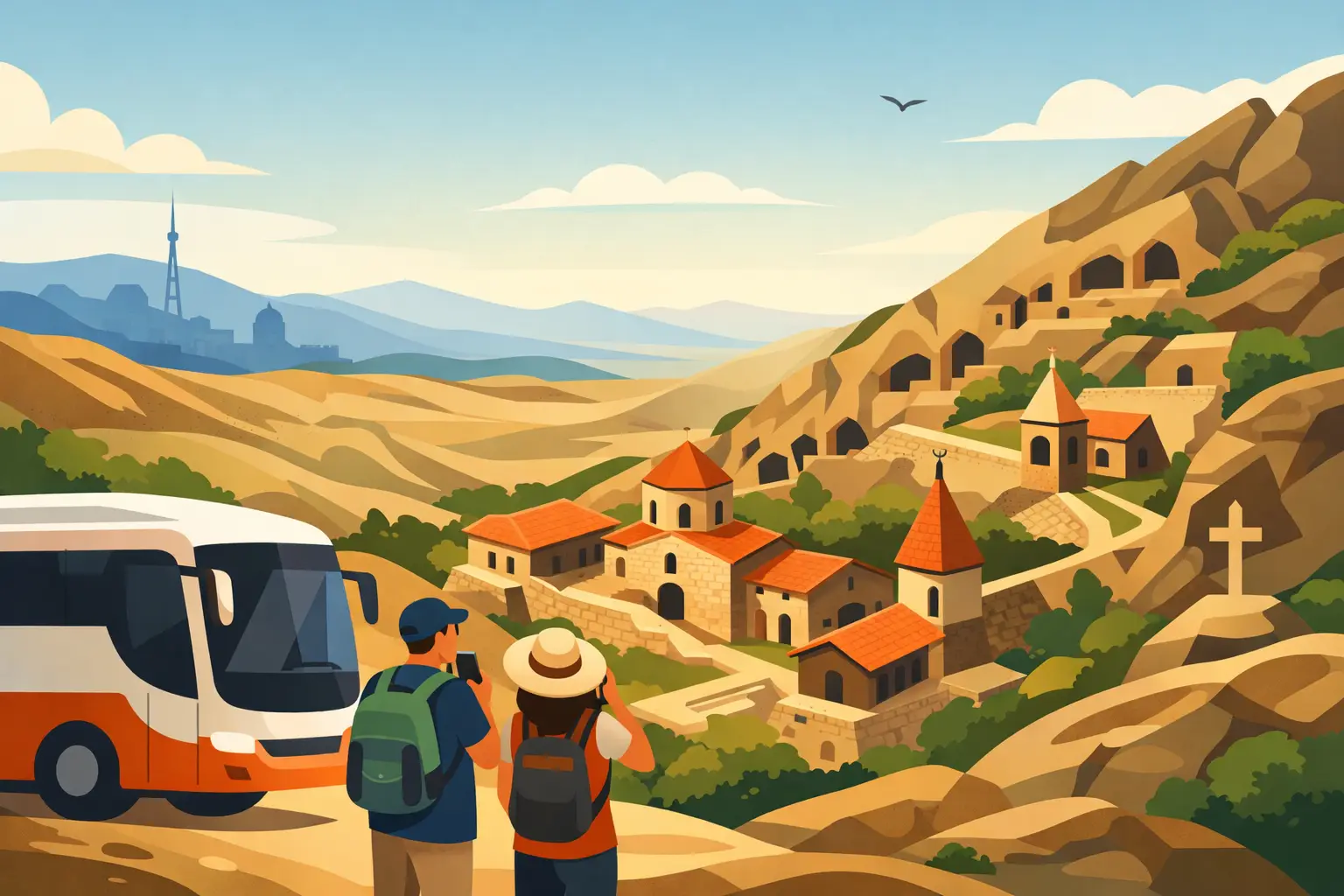
The road east from Tbilisi gradually trades city traffic for wide, wheat-colored plains, then for a stark, wind-swept landscape where the horizon seems almost endless. A David Gareja monastery tour is one of Georgia’s most surprising day trips: an early Christian cave complex set in semi-desert, close to the Azerbaijan border and far from the green mountain image many visitors expect.
This is not a museum visit with polished floors and display cases. It is a living religious site, a historic monastic landscape, and a journey through one of the country’s most dramatic regions. For travelers who want ancient culture, open landscapes, and a memorable contrast to Tbilisi, David Gareja delivers all three in a single day.
What makes David Gareja worth the journey
David Gareja is a sprawling monastic complex founded in the 6th century by St. David Garejeli, one of the Thirteen Assyrian Fathers who helped establish monastic life in Georgia. The site is named for him, but it is much larger than one monastery. Across the rocky hills and surrounding desert are monasteries, caves, chapels, cells, refectories, and water systems shaped over many centuries.
Most day tours center on the Lavra Monastery, the best-known and most accessible part of the complex. Here, low stone walls and cave entrances blend into the slope of Mount Gareja. You can see monastic cells carved directly into the rock, a courtyard, defensive walls, and the main church area. The setting has a rare stillness, broken only by birds, wind, and the occasional bell.
The history feels especially vivid because the landscape remains so elemental. The monks who settled here faced heat, cold, isolation, and scarce water. Their answer was not to tame the terrain, but to work with it – carving spaces into the rock and collecting precious rainwater. A knowledgeable guide turns these quiet details into the heart of the visit.
What to expect on a David Gareja monastery tour
A typical full-day trip leaves Tbilisi in the morning and returns in the evening. The drive usually takes around two to two and a half hours each way, depending on traffic, road conditions, and the route. Much of the journey crosses the open plains of the Kakheti region, so the ride is part of the experience rather than simply transportation.
At Lavra, visitors generally walk on uneven ground, stone paths, and gentle slopes. It is manageable for most travelers with normal mobility, but this is not a fully accessible attraction. Comfortable closed-toe shoes are a much better choice than sandals, particularly after rain or during the colder months.
Inside the monastery area, respectful dress matters. Shoulders and knees should be covered, and women may be asked to cover their heads when entering certain churches. The atmosphere is active and devotional rather than theatrical, so speak quietly, follow your guide’s instructions, and ask before photographing people or religious services.
Tours often combine David Gareja with a stop for lunch, a local village meal, or a Kakheti wine tasting. That combination works beautifully: the morning brings ancient cave monasteries and desert scenery, while the afternoon introduces the food and wine traditions that make eastern Georgia so rewarding. If wine is not your focus, ask for an itinerary that gives more time to the monastery and landscape instead.
The cave frescoes and the border question
Many travelers have seen photographs of richly painted cave chapels high on the ridge above the main monastery. These belong largely to the Udabno section of David Gareja, where medieval frescoes once made a dramatic reward for a steep hike.
Access to this ridge can change because parts of the David Gareja complex lie near an undelimited section of the Georgia-Azerbaijan border. At times, the Udabno caves and ridge trail may be restricted or closed to visitors. Conditions can also shift with security guidance, weather, and local regulations.
That does not make a visit to David Gareja less worthwhile. Lavra itself remains an extraordinary destination, and the surrounding terrain is reason enough to go. But it does mean travelers should avoid booking with the expectation that a particular ridge hike or frescoed chapel is guaranteed. A responsible local operator will confirm the current access situation close to your travel date and plan the day around what is permitted.
When to go: spring color or autumn light
Spring and fall are the most comfortable seasons for a David Gareja monastery tour. From April through early June, the desert can show surprising green growth and wildflowers, while daytime temperatures are usually pleasant for walking. September and October bring clear air, golden light, and the energy of grape harvest season in Kakheti.
Summer offers long days and strong, beautiful light, but the area can become intensely hot. There is very little shade around the monastery, so bring a hat, sunglasses, sunscreen, and more water than you think you need. An early departure makes a major difference in July and August.
Winter has its own appeal for travelers who enjoy solitude and stark scenery. The trade-off is cold wind, possible mud or ice on paths, and shorter daylight hours. Weather in this exposed area can feel more severe than the forecast in Tbilisi suggests, so layers are essential in every season.
How active is the visit?
For most guests, the main Lavra visit is an easy-to-moderate cultural walk rather than a strenuous hike. Expect steps, uneven surfaces, and standing while your guide explains the monastery’s history. Families with older children, couples, solo travelers, and small groups usually find it very approachable.
The experience becomes more active if accessible ridge trails are included. Those walks may involve steep, loose, rocky terrain with no railings or shade. They are best for confident walkers wearing shoes with good grip. If you have knee concerns, limited balance, or simply prefer a gentler day, choose an itinerary focused on Lavra, scenic stops, and Kakheti hospitality.
This distinction is worth making when you book. “David Gareja” can mean a quiet cultural day, a photo-focused desert excursion, or a more demanding monastery-and-hike adventure. The best tour is the one that matches your interests and comfort level, not the one with the longest checklist.
What to bring for the desert monastery
Pack lightly, but do not treat the site like a quick city attraction. Water, sun protection, and a light jacket belong in every day bag. Closed-toe walking shoes are practical year-round, while modest clothing helps you enter religious areas comfortably.
A small snack is useful, particularly if lunch is scheduled later in the afternoon. Bring cash in Georgian lari for personal purchases or local treats, though many organized tours include the main transportation and guide services. Mobile reception can be inconsistent outside larger settlements, so download any maps, translations, or essential travel details before leaving Tbilisi.
Photography is one of the great pleasures of the route. The desert plains, layered rock, distant ridges, and warm stone walls are particularly striking in soft morning or late-afternoon light. A phone is enough for most visitors, but carry a portable battery if you plan to photograph throughout the day.
Pair David Gareja with Kakheti flavors
The monastery sits on the edge of Kakheti, Georgia’s celebrated wine country. Adding a meal or cellar visit gives the journey a satisfying rhythm: silence and stone in the morning, then fresh bread, seasonal vegetables, cheese, grilled dishes, and traditional qvevri wine later in the day.
For a first-time visitor to Georgia, this pairing reveals something essential about the country. Georgian travel is rarely one-dimensional. A single day can move from a 6th-century spiritual settlement to a family table, from dry steppe to vineyard, and from the history of Orthodox Christianity to a toast made in an earthenware wine vessel.
Color Tour Georgia can arrange David Gareja as a guided day trip from Tbilisi or as part of a wider Kakheti itinerary. Private touring is especially useful for travelers who want a flexible pace, dedicated photo stops, a tailored lunch, or a route that suits children and mixed activity levels.
Before you set out, confirm current site access, the planned walking level, meal arrangements, and pickup time. Then leave room for the unexpected: a shepherd moving across the plain, a sudden shift in desert light, or the cool interior of a chapel carved into rock more than a thousand years ago. Those are the moments that stay with you long after the road brings you back to Tbilisi.