


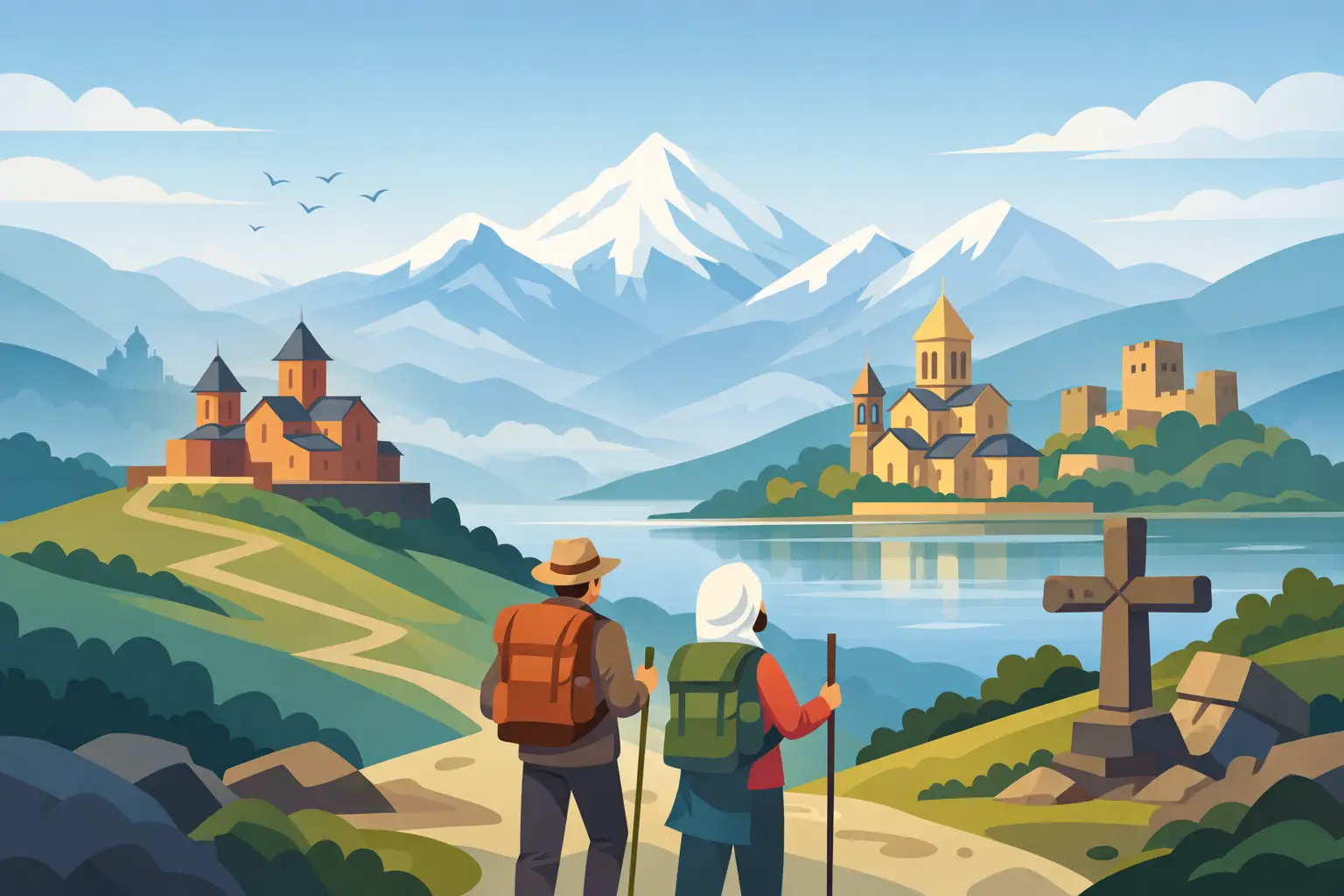
A church bell carries differently in the Caucasus. In Mtskheta, it may ring over the confluence of two rivers and the worn stones of Georgia’s old royal capital. High above Kazbegi, it can seem to rise from the clouds around Gergeti Trinity Church. Georgia pilgrimage tours connect these powerful moments with the living faith, hospitality, food, and mountain landscapes that make the country far more than a sequence of historic monuments.
Georgia is one of the world’s oldest Christian countries, and its sacred sites remain active places of worship. A meaningful journey here is not just about checking off famous cathedrals. It is about understanding why a monastery was built on a ridge, sharing a table after a service, hearing the chant of Georgian polyphony, and allowing time for quiet in places where faith has endured through centuries of invasions, kingdoms, and changing borders.
Why Georgia Pilgrimage Tours Feel Personal
Christianity became the state religion of Georgia in the early fourth century, traditionally through the mission of St. Nino. Her story is woven into the country’s spiritual geography, especially in Mtskheta, where the towering Svetitskhoveli Cathedral stands as one of Georgia’s most revered churches. According to tradition, it holds the robe of Christ, making it a central destination for Orthodox pilgrims.
Yet Georgia’s sacred landscape is remarkably varied. One day may begin at Jvari Monastery, perched above Mtskheta with wide views across the Aragvi and Mtkvari rivers. The next may lead through Kakheti’s vineyards to the convent of Bodbe, associated with St. Nino and surrounded by peaceful gardens. Further west, ancient monasteries, cave complexes, and quiet village churches reveal another side of the country’s religious history.
For many visitors, the experience is moving whether they travel as practicing Orthodox Christians, Christians from another tradition, or culturally curious guests. The essential distinction is respect. These churches are not frozen museum pieces. Services, baptisms, weddings, and private prayer are part of everyday life, and a good itinerary leaves room for that reality.
Sacred Places Worth Building a Route Around
A first pilgrimage itinerary often begins in and around Tbilisi, where the capital’s old neighborhoods hold churches from different eras and traditions. Anchiskhati Basilica, generally recognized as Tbilisi’s oldest surviving church, offers an intimate contrast to the grander Holy Trinity Cathedral, known locally as Sameba. Both help visitors see how Georgian faith lives in a modern capital as well as in remote valleys.
Mtskheta: Georgia’s Spiritual Heart
Just outside Tbilisi, Mtskheta is the natural starting point for many Georgia pilgrimage tours. Svetitskhoveli Cathedral and Jvari Monastery can be visited in a day, but they deserve unhurried attention. Arriving early or later in the afternoon often brings a calmer atmosphere, particularly in the busy travel months.
Samtavro Monastery is another meaningful stop in Mtskheta. It is closely connected with St. Nino and King Mirian, whose conversion shaped Georgian Christian history. Together, these sites create a strong introduction to the country’s early church, royal past, and continuing Orthodox traditions.
Kakheti: St. Nino, Monasteries, and Wine Country
Kakheti is ideal for travelers who want pilgrimage travel with Georgia’s food and wine culture close at hand. Bodbe Monastery near Sighnaghi is one of the country’s most loved holy places, with views over the Alazani Valley and the Caucasus beyond. Pilgrims may visit St. Nino’s grave, while other travelers are drawn by the calm grounds and the sense of place.
The region also holds historic monastic centers such as Alaverdi Cathedral, with its striking setting among vineyards, and the David Gareja monastic complex in the semi-desert east. David Gareja is especially memorable for its rock-hewn chapels and painted caves, but access can change because of its location near the Azerbaijan border. It should always be planned with current local advice rather than treated as a fixed stop.
Mountains, Caves, and Western Georgia
For a more dramatic route, Gergeti Trinity Church above Stepantsminda offers one of Georgia’s iconic pilgrimage landscapes. The church is reachable by road or on foot, depending on weather, fitness, and the experience you want. The view is extraordinary, but conditions in the mountains are real: fog, wind, and sudden weather shifts can change the day quickly.
In the south, Vardzia adds another dimension. This vast cave city and monastery complex was carved into a cliff in the 12th century, and its Church of the Dormition still contains important frescoes. It works well within a longer cultural route that includes Akhaltsikhe, Sapara Monastery, and Georgia’s volcanic highlands.
Western Georgia can add Kutaisi’s sacred heritage, including Bagrati Cathedral and the Gelati Monastery complex. Gelati is especially significant for its medieval scholarship, mosaics, and royal connections. Restoration work or site-management arrangements can affect what visitors see, so a flexible plan is wiser than promising identical access year-round.
Planning a Pilgrimage With the Right Pace
The most rewarding pilgrimage tours are designed around rhythm, not distance alone. Georgia is compact on a map, but mountain roads, village stops, weather, and the desire to spend meaningful time at each church all affect a route. Trying to cover Tbilisi, Mtskheta, Kakheti, Kazbegi, Kutaisi, and Vardzia in a few days creates a rushed sightseeing trip rather than a pilgrimage.
For a first visit, four to six days can focus well on Tbilisi, Mtskheta, and Kakheti. A week or more allows travelers to add Kazbegi, Vardzia, or western Georgia without spending every day in transit. Larger groups and church communities may also want time for a private prayer service or meeting with local clergy, subject to church availability and appropriate advance arrangements.
Spring and fall are often the most comfortable seasons for a broad route. April through June brings green hills and cooler temperatures, while September and October combine clear light, harvest activity, and the energy of wine season. Summer is excellent in the mountains but can be hot in Tbilisi, Kakheti, and Vardzia. Winter has a special quiet beauty, though high mountain roads may be affected by snow.
Church Etiquette That Helps You Travel Respectfully
A little preparation makes visits more comfortable for both pilgrims and local congregations. Many Georgian Orthodox churches ask women to cover their heads and wear skirts or dresses below the knee. Men should generally wear long pants, and everyone should avoid sleeveless tops, shorts, and overly casual beachwear. Some churches provide scarves or wrap skirts at the entrance, but bringing your own is the simplest choice.
Photography rules vary. It is best to ask a guide or church attendant before taking pictures, especially during services. Keep voices low, silence phones, and do not move through worshippers to get a better view. If you are uncertain how to light a candle, where to stand, or whether a particular area is open, ask rather than assume.
Pilgrimage travel also calls for practical comfort: modest layered clothing, shoes suitable for uneven stone paths, a reusable water bottle, and a light rain layer are useful across most regions. At mountain churches and remote monasteries, toilets, shops, and cell service may be limited.
Beyond the Church Door
Georgia’s spiritual hospitality often continues at the table. A monastery visit may be followed by khachapuri from a family bakery, a simple lunch of beans and fresh bread, or a traditional supra where a toast expresses gratitude, remembrance, and friendship. In Kakheti, wine is not separate from culture and faith. The qvevri winemaking tradition has shaped family life for generations, and even a short cellar visit can add context to the region’s monastery routes.
This is also why guided travel can make such a difference. A knowledgeable local guide can explain what you are seeing without turning a sacred space into a lecture hall, adjust the route when weather or access changes, and make practical details like transport, accommodations, and meal stops feel well considered. Colour Tour Georgia can help shape a route around your group’s faith, interests, comfort level, and available travel time.
Come with a camera, certainly, but also with patience. Sit for a few quiet minutes after the group has moved on, listen for the chant or the wind outside, and let Georgia reveal its faith at its own pace.