


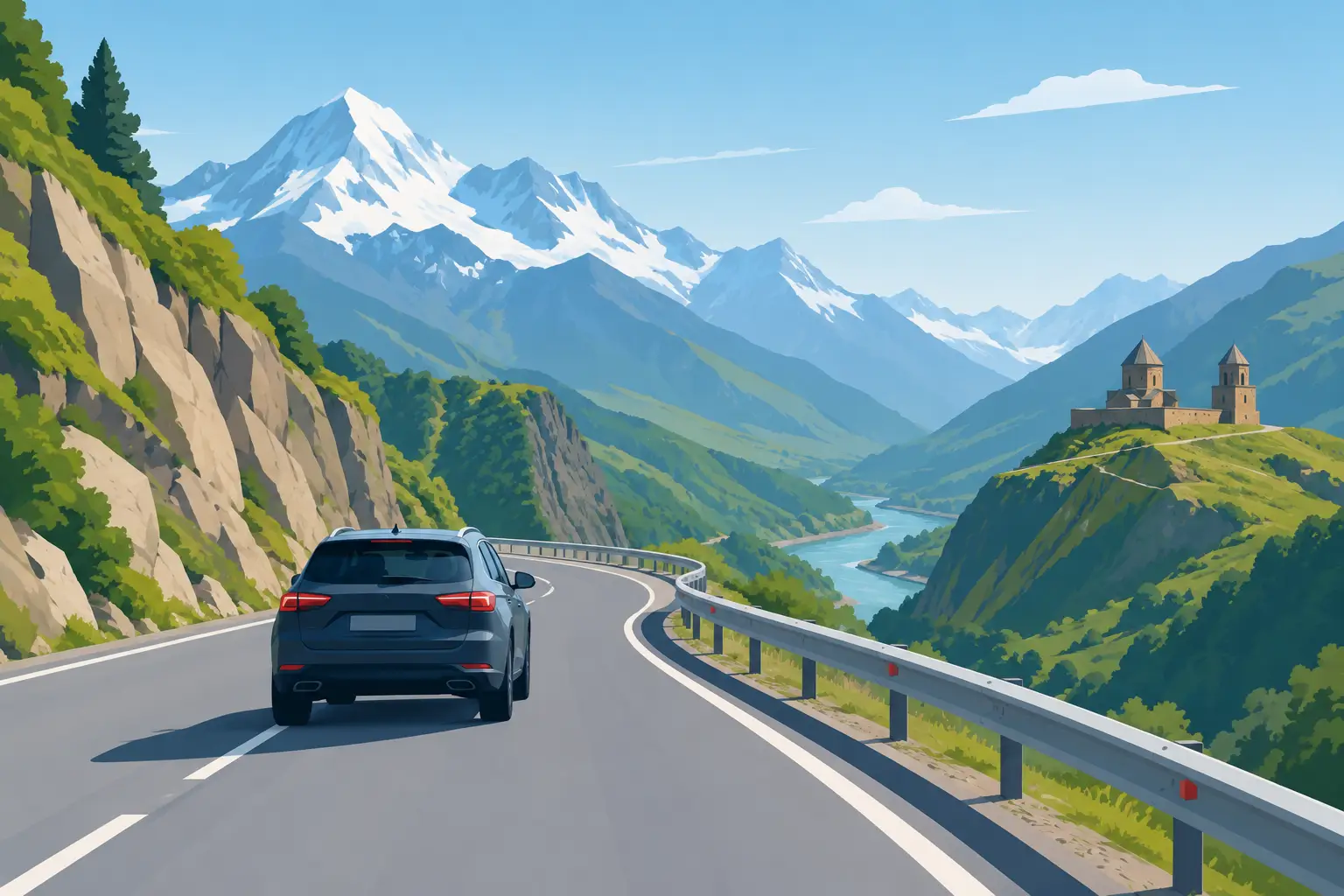
The moment the city fades behind you, the landscape begins to rise. To drive Georgian Military Highway is to travel from Tbilisi’s busy streets into the heart of the Greater Caucasus, past medieval fortresses, dramatic reservoirs, high mountain passes, and villages beneath Mount Kazbek. It is one of Georgia’s most rewarding road trips, but it is not simply a scenic drive to take lightly.
The route is paved and accessible for much of the year, yet weather, truck traffic, altitude, and changing mountain conditions shape every journey. With the right timing, a sensible vehicle choice, and room in your schedule for stops, the Georgian Military Highway can become one of the unforgettable days of a Colorful Georgia vacation.
The Route: Tbilisi to Stepantsminda
The Georgian Military Highway follows the main northbound road from Tbilisi through Mtskheta and the Aragvi Valley to Stepantsminda, the mountain town widely known to travelers as Kazbegi. The full drive is roughly 95 miles (153 kilometers) and, without stops or traffic, takes around three to three-and-a-half hours.
In reality, plan for a full day. This is not a route to rush. The road climbs steadily, and the best experiences are spread along the way: the Ananuri fortress complex, the blue waters of Zhinvali Reservoir, the confluence of the Black and White Aragvi rivers, Gudauri’s alpine viewpoints, and the high Jvari Pass.
Beyond Stepantsminda, the road continues to the Upper Lars border crossing with Russia. Unless you have specific onward travel plans, valid documents, and confirmation that the crossing is operating, Stepantsminda is the natural endpoint for a day trip from Tbilisi.
When to Drive Georgian Military Highway
The best season depends on the kind of Georgia you want to see. From late spring through early autumn, the highway offers green valleys, open hiking trails, and long daylight hours. June through September is generally the easiest period for first-time visitors driving independently, although summer weekends can bring busy roads and slow-moving traffic near popular viewpoints.
Autumn brings clear light, colder evenings, and beautiful color in the lower valleys. It can be an excellent time for photographers and travelers who prefer quieter roads. By October, however, weather at higher elevations can change quickly.
Winter creates a completely different experience. Gudauri becomes Georgia’s leading ski destination, and the snow-covered Caucasus is magnificent. But this is also when snow, ice, wind, avalanche control, and temporary road closures are most likely. The section around Gudauri and Jvari Pass can be especially affected. A winter drive should be made only with a properly equipped vehicle, current road information, and confidence in mountain driving.
Spring is equally unpredictable. Lower elevations may feel warm and bright while the pass remains snowy or temporarily closed. If your trip has limited flexibility, a guided transfer or private driver is often the easier choice during winter and early spring.
Choose the Right Vehicle, Not Just the Cheapest One
For a dry summer drive from Tbilisi to Stepantsminda, a standard rental car is often sufficient because the main highway is paved. You do not need a 4×4 simply to reach Kazbegi town, Ananuri, or Gudauri.
That said, a higher-clearance vehicle becomes valuable if you plan to continue beyond the highway. The road to Gergeti Trinity Church is steep and can be rough, especially after rain. A 4×4 is also a better fit for travelers adding remote valleys, unpaved village roads, or more adventurous Caucasus routes to their itinerary.
Avoid treating this road like a highway in the American sense. Lanes can be narrow, curves are frequent, and heavy trucks use the route as a major international transport corridor. You may encounter trucks moving slowly uphill, then cars attempting impatient overtakes. Keep a generous following distance and do not pass unless you have a long, clear view of the road ahead.
Before leaving Tbilisi, check that you have enough fuel, a charged phone, offline maps, drinking water, and warm layers. Temperatures in Stepantsminda and at the pass can be dramatically cooler than in the capital, even in July.
The Stops Worth Making Along the Way
Zhinvali Reservoir and Ananuri Fortress
About an hour from Tbilisi, Zhinvali Reservoir introduces the mountain scenery with broad blue water framed by forested slopes. A few minutes farther on, Ananuri Fortress stands above the reservoir. Its stone towers, churches, and defensive walls date largely from the 16th and 17th centuries and reflect the region’s long history of mountain rulers, trade routes, and conflict.
Ananuri is an easy first stop because it combines culture, views, and a chance to stretch your legs before the road begins climbing in earnest. Dress modestly if entering the churches, and remember that these are active religious spaces as well as historic monuments.
Pasanauri and the Aragvi Rivers
Near Pasanauri, look for the meeting point of the Black and White Aragvi rivers. Their waters can appear noticeably different in color, particularly after rain or snowmelt. The area is also strongly associated with khinkali, Georgia’s famous soup dumplings.
A roadside khinkali lunch can be memorable, but it is wise to choose a place that looks busy with local diners and to allow time afterward. Mountain driving on a full stomach is not everyone’s favorite activity, especially on a road with many curves.
Gudauri and the Russia-Georgia Friendship Monument
Gudauri sits high in the mountains and is best known for winter skiing, but it is striking in every season. In summer, grassy slopes and open views replace ski runs; in winter, the surrounding peaks become a world of snow and high-altitude sport.
The circular Russia-Georgia Friendship Monument near Gudauri is a popular viewpoint overlooking the Devil’s Valley. It is visually dramatic, though it can be crowded during peak travel periods. Park carefully, watch children closely near unfenced edges, and expect strong wind.
Jvari Pass and Travertine Mineral Springs
The road reaches its highest point at Jvari Pass, at roughly 7,800 feet (2,379 meters). The scenery here feels wonderfully open, with wide slopes, distant ridges, and changing clouds. Stop only in designated or genuinely safe pull-off areas. Visibility can deteriorate rapidly in fog, rain, or snow.
Near the pass, mineral-rich water has created distinctive orange and white travertine formations on the hillside. They are easy to spot and make a quick, unusual photo stop. Treat the landscape with care: do not climb on fragile formations or leave litter behind.
Arriving in Stepantsminda
Stepantsminda is more than a viewpoint stop. It is a mountain base for hiking, horse riding, 4×4 excursions, snowshoeing, and overnight stays beneath Mount Kazbek. The town has guesthouses, hotels, small restaurants, and local drivers who can take visitors toward Gergeti Trinity Church.
The church, perched high above town with Mount Kazbek often rising behind it, is the image many travelers associate with Georgia. You can hike up in favorable weather, arrange a local 4×4 transfer, or simply admire it from below. The hike is rewarding but steep, so allow several hours and do not start late in the day.
If your schedule permits, spend a night in Stepantsminda rather than driving back immediately. Morning cloud often lifts to reveal the mountain, and an overnight stay gives you time for a calmer visit to Gergeti, a short walk in the valley, or a meal of local mountain cuisine without watching the clock.
Mountain Road Safety That Matters
Conditions on the Georgian Military Highway can change within hours, particularly from November through April. Check the forecast before departure, but also understand that a forecast is not a road-status guarantee. Snowfall, high winds, landslides, and avalanche prevention work may affect the route with little notice.
Follow these practical rules:
- Do not drive the pass after dark if you are unfamiliar with mountain roads.
- In winter, use winter tires and carry chains if conditions or rental requirements call for them.
- Never assume a navigation app accounts for a sudden closure, ice, or a blocked lane.
- Keep your plans flexible, especially if you have a same-day flight, train, or fixed hotel check-in after the drive.
Mobile service is often available along the route, but it can weaken in mountainous sections. Download maps in advance and tell someone your intended itinerary if you are traveling independently. If conditions look poor, turn back or wait. The mountains will still be there tomorrow.
Self-Drive or Private Driver?
A self-drive trip offers freedom. You can linger at Ananuri, stop for photographs whenever it is safe, and decide whether Kazbegi deserves an extra night. It suits confident drivers visiting in stable weather, especially from late spring to early fall.
A private driver or guided day tour makes more sense if you want to focus fully on the scenery, travel in winter, are nervous about mountain roads, or prefer local insight at each stop. It also removes the stress of parking, overtaking trucks, and judging weather around the pass. For families, small groups, and travelers with a tight itinerary, that comfort can be worth far more than the extra flexibility of driving yourself.
Leave Tbilisi early, keep the day unhurried, and let the road set the pace. On the Georgian Military Highway, the journey to Kazbegi is not the gap between attractions – it is one of Georgia’s great attractions itself.