


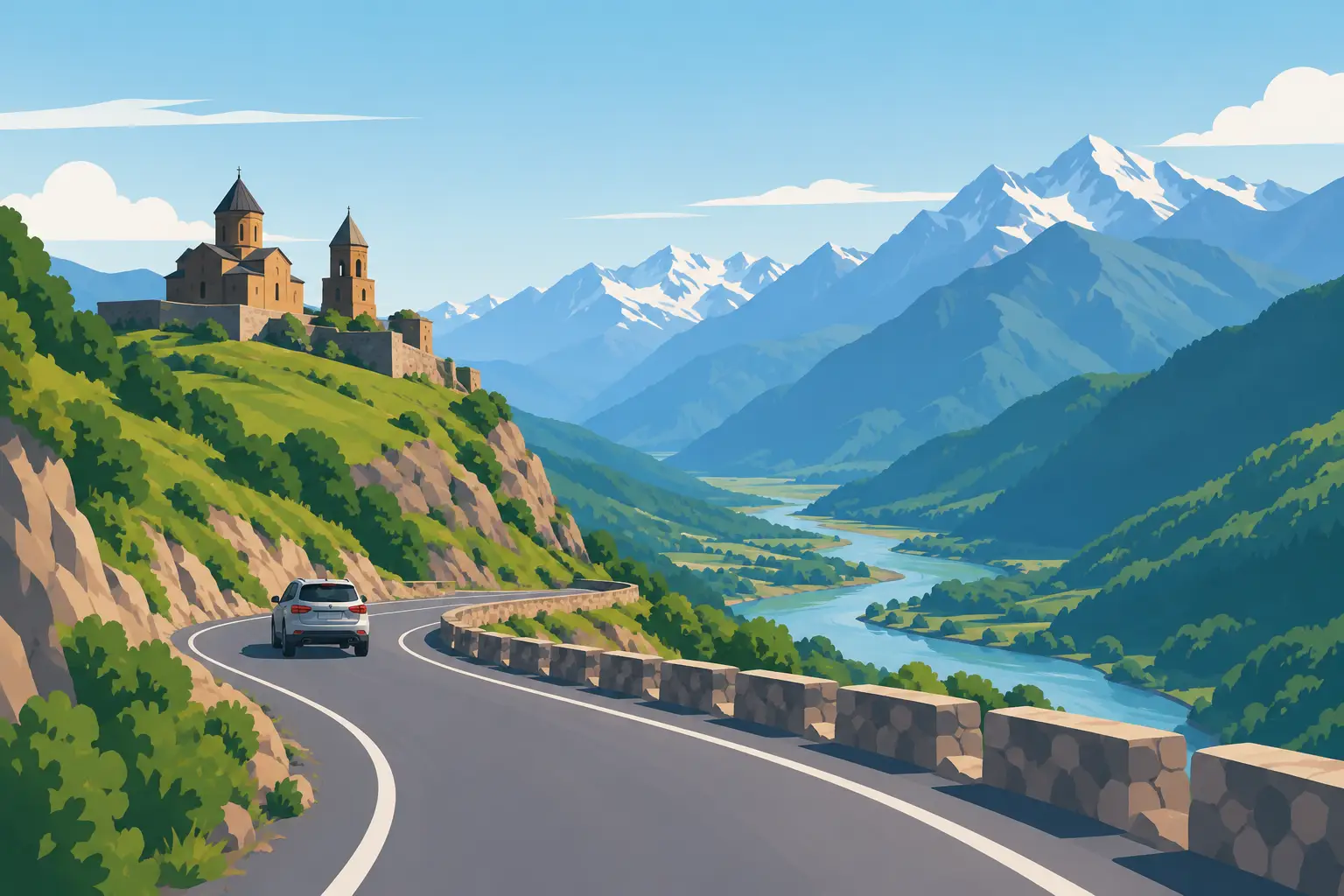
The road to Kazbegi is not simply a transfer from Tbilisi to the mountains. It is one of Georgia’s great travel experiences: a changing sequence of old fortresses, deep reservoirs, roadside khinkali, high alpine slopes, and the dramatic first sight of Mount Kazbegi. The best scenic Georgian Military Highway stops turn a long drive into a full, colorful day in the Caucasus.
Known locally as the Georgian Military Road, this historic route connects Tbilisi with Stepantsminda near the Russian border. It can be completed on a day trip, but the road rewards travelers who allow time for viewpoints, local food, and the unexpected weather that gives these mountains their character. For photographers, history lovers, families, and first-time visitors to Georgia, it is one of the country’s most accessible big-landscape adventures.
Scenic Georgian Military Highway Stops Worth Your Time
1. Jvari Monastery and the Mtskheta View
A short detour before joining the main mountain road, Jvari Monastery is an especially rewarding beginning. The compact sixth-century church stands high above Mtskheta, where the Aragvi and Mtkvari rivers meet below. From the terrace, the view puts Georgia’s geography and history into one frame: green hills, the former capital, and the old cathedral town at the crossroads of ancient routes.
If you have only one day for Kazbegi, Jvari is best treated as a brief early stop. Travelers with a stronger interest in religious heritage may prefer to combine the highway with a longer visit to Mtskheta and Svetitskhoveli Cathedral on another day. That trade-off leaves more time for the high mountains ahead.
2. Zhinvali Reservoir
As the road climbs north, the landscape opens around the turquoise waters of Zhinvali Reservoir. Its color changes with the season and the light, from bright blue-green on clear days to a moody slate tone under rain clouds. Several roadside pull-offs offer broad views over the water and surrounding forested slopes.
This is primarily a photo stop, but it also marks the transition from the urban edge of Tbilisi into the mountains. In summer, the reservoir can look almost Mediterranean. In late autumn and winter, mist and low clouds give it a completely different, more dramatic atmosphere.
3. Ananuri Fortress
Ananuri is the Georgian Military Highway’s essential historical stop. The walled complex sits beside the reservoir and was once a stronghold of the powerful Aragvi dukes. Its towers, defensive walls, and churches are compact enough to explore in 30 to 45 minutes, while the carved stone details on the Church of the Assumption deserve a closer look.
The setting is part of the appeal. From the fortress walls, you see lake water, steep hillsides, and the old road corridor that has linked central Georgia to the north for centuries. Arrive earlier in the day if possible, especially from May through October, when the site is busiest with day-trip groups.
4. Pasanauri and a Khinkali Lunch
Pasanauri is a practical and delicious pause on the route. The small town is widely associated with khinkali, Georgia’s famous soup dumplings, traditionally filled with spiced meat and broth. Eating them properly is part of the experience: hold the top knot, take a small bite, sip the broth, then enjoy the filling. The knot is usually left on the plate.
A full khinkali lunch is not ideal for every traveler before a winding mountain drive. If carsickness is a concern, choose a lighter meal, eat a smaller portion, or save the feast for the return to Tbilisi. Vegetarian travelers can usually find cheese, potato, mushroom, or herb-filled options, though availability varies by restaurant and season.
5. The Aragvi Valley Viewpoints
Beyond Pasanauri, the route follows the White and Black Aragvi valleys, with the road threading between wooded slopes and increasingly steep mountain walls. This portion is less about one famous monument and more about watching the scenery change through the vehicle window.
Ask your driver or guide to stop safely at a designated pull-off when the weather is clear. The best viewpoints are not always marked by a large sign, and stopping on narrow roadside shoulders is not worth the risk. A guided trip is particularly useful here because local drivers know which pull-offs offer the best views without disrupting traffic.
6. Gudauri’s High-Mountain Slopes
Gudauri is Georgia’s best-known ski resort and a major stop even outside winter. In the snowy season, its broad slopes and modern lifts attract skiers and snowboarders from across Europe and beyond. During summer, the same open terrain becomes a place for hiking, mountain biking, horseback riding, and paragliding.
For travelers on a classic Tbilisi-to-Kazbegi day tour, Gudauri is usually a scenic stop rather than an overnight destination. But it is worth extending your journey if you want time on the slopes in winter or a high-altitude active break in warmer months. Weather can be sharply colder here than in Tbilisi, even in July, so carry a warm layer and rain protection.
7. Russia-Georgia Friendship Monument
The circular mosaic monument near Gudauri is one of the route’s most photographed locations. Built in 1983, it overlooks the sweeping Devil’s Valley and features a large Soviet-era mural inside its curved stone structure. The artwork is historically complex, but the viewpoint itself is spectacular.
This is where the Caucasus begins to feel truly enormous. On a clear day, ridges stretch far into the distance, and paragliders often float above the valley in summer. Keep children close near the viewing area and avoid stepping beyond barriers for photos. The winds can be strong, and the drop-offs are real.
8. Jvari Pass and the Stone Heads
The road reaches one of its highest points at Jvari Pass, also called the Cross Pass, at roughly 7,800 feet above sea level. The pass is marked by a large stone cross and delivers a stark alpine landscape that contrasts with the greener valleys farther south.
Near the road, you may also see mineral-rich travertine formations, sometimes called the Georgian “orange waterfall.” Water trickles over rust-colored rock, creating a surprising splash of color against the gray and green mountains. It is a quick stop, but a memorable one, particularly after rainfall or snowmelt.
9. Kobi and the Descent Toward Kazbegi
North of the pass, the landscape changes again as the road drops toward Kobi and the Terek River valley. The slopes become more rugged, with narrow gorges, waterfalls, and high peaks often wrapped in cloud. This stretch can feel quiet compared with Gudauri, especially outside the busiest summer period.
Road conditions and traffic can determine how long you spend here. The highway is an active international route to the Upper Lars border crossing, so trucks and delays are common. In winter, heavy snow, avalanche-control work, and temporary restrictions can affect schedules. A flexible itinerary is always smarter than a tightly timed plan.
10. Gergeti Trinity Church and Mount Kazbegi
The journey’s final reward is Stepantsminda, often known by its former name, Kazbegi. From town, Gergeti Trinity Church stands on a grassy ridge beneath Mount Kazbegi, one of the most iconic images in Georgia. The fourteenth-century church is small and austere, but its setting is unforgettable.
A local 4×4 transfer is the usual way to reach Gergeti, as the mountain road can be rough and muddy after rain. Confident hikers can walk up, but allow several hours for the round trip and be prepared for steep terrain and rapidly changing weather. On a clear morning, the church, valley, and glacier-covered peak create a view that feels almost unreal.
How to Plan the Highway as a Day Trip
A Tbilisi to Kazbegi day trip commonly takes 10 to 12 hours, depending on stops, traffic, season, and whether you continue to Gergeti Trinity Church. Leaving early makes a meaningful difference. It gives you quieter time at Ananuri, better odds of clear mountain views, and less pressure if road conditions slow the journey.
A private car offers the most freedom for photographers, families, and travelers who want a relaxed lunch or an extra stop. A small-group guided tour is a strong value for visitors who prefer local context and do not want to manage mountain driving. Self-driving is possible, but mountain weather, passing trucks, and winter road conditions make it better suited to experienced drivers.
Bring water, sunglasses, sunscreen, a windproof layer, and comfortable shoes. Mobile signal is generally available along much of the route but can weaken in mountain sections. Keep cash in Georgian lari for small purchases, roadside snacks, and local 4×4 transfers.
The Georgian Military Highway is beautiful in every season, but each one asks for a different kind of traveler. Summer brings green valleys and long days, while autumn adds golden hillsides and clearer air. Winter offers snow-covered drama and skiing in Gudauri, though weather-related delays are more likely. Spring can be lush and powerful, with waterfalls at their fullest, but rain and fog may hide the very peaks you came to see.
Take the route with curiosity rather than a checklist. A fortress, a steaming plate of khinkali, a sudden cloud break over Mount Kazbegi – these are the moments that make a highway day feel like a true encounter with unforgettable Georgia.