


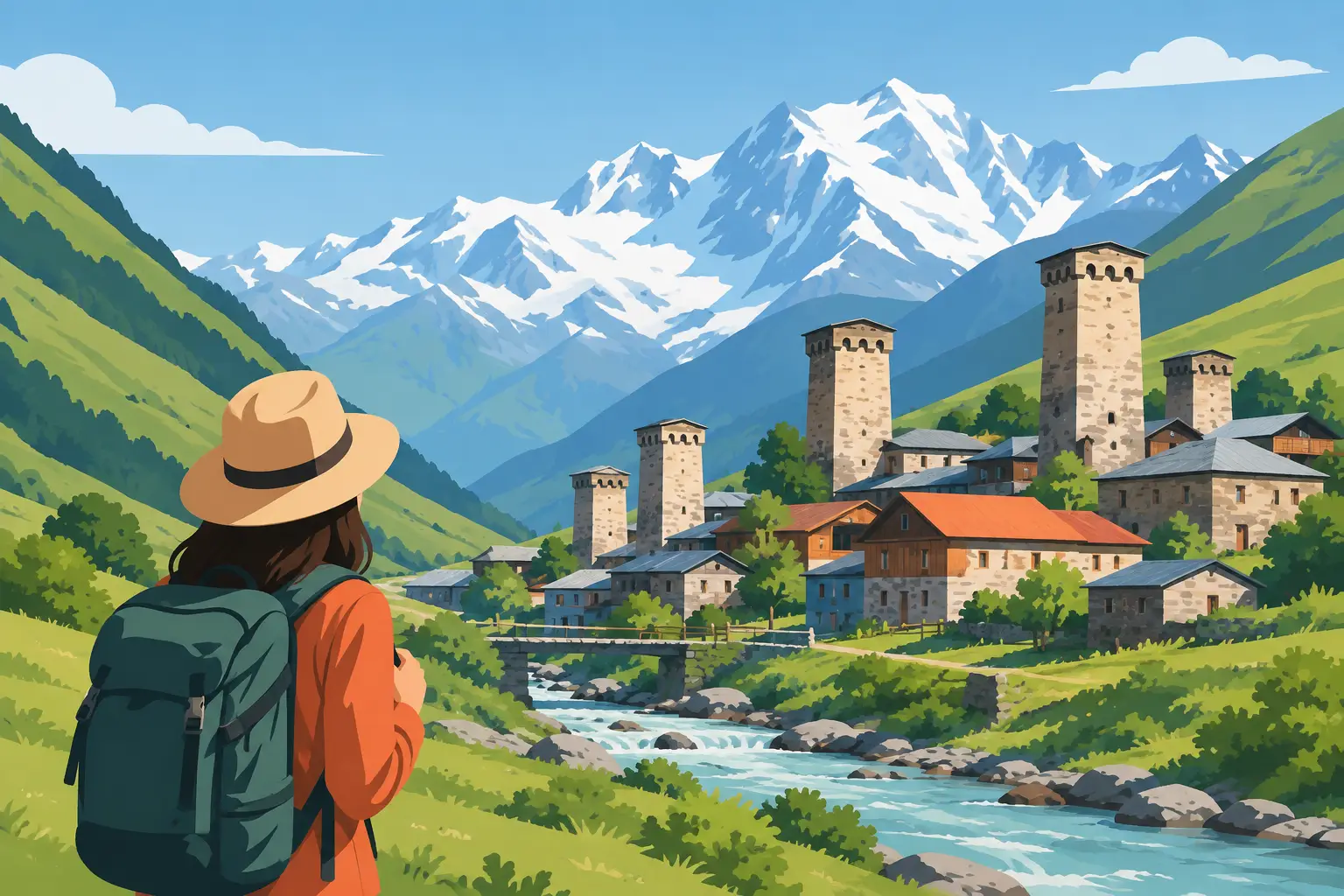
At more than 7,000 feet in Georgia’s Upper Svaneti region, Ushguli feels less like a quick sightseeing stop and more like a place at the edge of the map. This Ushguli village travel guide helps you plan for the road, the weather, and the quiet rewards of staying in one of Europe’s highest permanently inhabited communities.
Ushguli is a group of four small villages – Zhibiani, Chvibiani, Chajashi, and Murqmeli – rather than one compact village center. Stone defensive towers, wooden balconies, grazing horses, and the snow-covered mass of Mount Shkhara create a landscape that is dramatic in every direction. The setting is extraordinary, but it is remote mountain country. Good planning turns the journey from a logistical challenge into one of the most memorable parts of a Georgia itinerary.
Why Ushguli Is Worth the Journey
Ushguli belongs to the historic Upper Svaneti landscape, known for its medieval tower houses and enduring mountain culture. These towers were built by Svan families over centuries as homes, storehouses, and places of protection during conflict. They are not museum props. Many remain part of the living fabric of the villages, alongside working farms, family guesthouses, and narrow lanes where cattle still have the right of way.
The village’s greatest appeal is its sense of scale. In Tbilisi, Georgia’s history unfolds through churches, courtyards, wine cellars, and lively streets. In Ushguli, history is framed by glaciers and high ridgelines. It is a destination for travelers who want to slow down, walk without a strict schedule, and wake up somewhere that feels profoundly different from a conventional European mountain resort.
That said, Ushguli is not for travelers looking for polished nightlife, a large selection of restaurants, or guaranteed luxury amenities. Accommodations are generally simple, warm, and characterful. The trade-off is an authentic base in one of the Caucasus Mountains’ most striking settings.
How to Reach Ushguli From Mestia
Most visitors reach Ushguli from Mestia, the main hub of Svaneti. The route is roughly 28 miles, but distance is misleading here. The road winds through steep valleys and sections can be unpaved, narrow, muddy, or affected by rockfall. Travel time commonly ranges from two to three hours each way, depending on weather and road conditions.
A local 4×4 vehicle with an experienced driver is the sensible choice. Shared vehicles may operate in the warmer months, while private transfers offer more flexibility for photo stops, luggage, and changing plans. Self-driving can suit confident travelers with mountain-road experience, but it is not the place to test those skills for the first time. Conditions can change quickly after rain, snow, or maintenance work.
To reach Mestia, travelers usually fly from Tbilisi or Kutaisi when schedules and weather allow, or travel overland from Kutaisi, Zugdidi, or Tbilisi. The overland route is scenic but long, so an overnight stay in Mestia before continuing to Ushguli is strongly recommended. It makes the journey safer, less rushed, and far more enjoyable.
For travelers who prefer a planned route with reliable transport, a Svaneti itinerary arranged by a local operator such as Color Tour Georgia can combine Mestia, Ushguli, accommodation, and guided walks in one trip.
When to Visit Ushguli
Summer: Best for hiking and easier access
Late June through September is the most practical period for most visitors. The road from Mestia is generally more accessible, guesthouses are open, and mountain trails are at their best. July and August bring greener slopes, wildflowers, and longer days, though this is also the busiest time and afternoon rain showers are common.
September is especially appealing for travelers who prefer fewer visitors and cooler hiking weather. Golden autumn colors begin to appear in the valleys, while higher summits may receive their first fresh snow. Bring layers even in midsummer – evenings can be cold at Ushguli’s elevation.
Spring and fall: Beautiful but less predictable
May, early June, and October can reward flexible travelers with quieter villages and vivid seasonal color. However, snowmelt, mud, and early snowfall can make the access road difficult or temporarily unavailable. Guesthouse options may also be more limited. These months work best when Ushguli is one part of a flexible Svaneti program rather than a tightly timed, one-night stop.
Winter: For experienced, well-supported travelers
Winter Ushguli is beautiful, silent, and serious. Deep snow can close the road or make travel highly dependent on specialized vehicles and local advice. It is not a casual day-trip destination in winter. Those seeking snowshoeing or winter photography should travel with an experienced local team, allow extra days, and be prepared for changing conditions.
What to Do in Ushguli
Walk between the four villages
The simplest experience is often the best. Walk slowly from one hamlet to another, look up at the Svan towers, and follow the paths used by residents and livestock. Chajashi is especially known for its concentration of historic towers and is part of the protected Upper Svaneti heritage area. Respect private homes, gardens, and farm buildings while exploring.
Visit Lamaria Church
The small Lamaria Church above the village is one of Ushguli’s essential stops. Its modest stone exterior fits naturally into the mountain setting, while the viewpoint looks across towers and fields toward Mount Shkhara. Dress modestly when entering any active church: covered shoulders and knees are appropriate, and women may wish to carry a scarf.
Hike toward Shkhara Glacier
The walk from Ushguli toward Shkhara Glacier is among Georgia’s classic high-mountain day hikes. The route follows the Enguri River valley beneath the country’s highest peak, Mount Shkhara, which rises to more than 17,000 feet. The scenery is immense, but do not underestimate the outing. Weather can turn rapidly, river crossings and trail conditions vary, and snow can remain at higher points well into summer.
A guided hike is a good idea for less experienced trekkers, early- or late-season visitors, and anyone planning to go beyond the commonly walked sections. Carry water, snacks, sun protection, a rain layer, and proper hiking shoes. Mountain sneakers may be enough on a dry, easy walk, but they are not ideal after rain.
Eat Svanetian food in a family guesthouse
Ushguli is a fine place to try Kubdari, the celebrated Svanetian meat pie seasoned with fragrant local spices. You may also find potato dishes, fresh cheese, soups, pickles, honey, and homemade bread. Meals are often prepared by the family running the guesthouse, which gives dinner a warmth that a standard restaurant cannot replicate.
Vegetarian travelers can be well fed in Georgia, but choices in remote villages are naturally narrower than in Tbilisi. Let your host know dietary needs in advance, especially for vegan, gluten-free, or allergy-sensitive meals.
Where to Stay and How Long to Plan
An overnight stay is the difference between seeing Ushguli and experiencing it. Day-trippers arrive when the road is busiest, take photographs, and leave before the late-afternoon light settles over the towers. Staying overnight gives you a quiet evening, a home-cooked dinner, and an early morning when the villages feel almost entirely your own.
For most visitors, one or two nights is ideal. One night works well for a relaxed village walk and a short hike. Two nights allow time for the Shkhara valley hike, weather flexibility, and a slower pace. Rooms are usually straightforward, with private bathrooms available in some guesthouses and shared facilities in others. Confirm heating, bathroom arrangements, meals, and payment preferences before arrival.
Carry some Georgian lari in cash. Card acceptance and ATM access can be limited in remote Svaneti, and mobile signal or Wi-Fi may be intermittent. Think of this as part of the experience, not a service failure: Ushguli is wonderfully remote precisely because it has not been built around constant connectivity.
Practical Tips for a Respectful Visit
Pack for temperature changes rather than the forecast alone. A waterproof jacket, insulating layer, hat, sunglasses, sunscreen, refillable water bottle, and sturdy footwear are useful in every summer month. Keep luggage manageable, since guesthouses may have stairs, uneven paths, or limited vehicle access.
Photography is welcome in the landscape, but ask before photographing people, children, religious services, or the inside of private property. A few words of Georgian or a warm greeting go a long way. Svaneti is proud of its distinct identity and traditions, and respectful curiosity is always appreciated.
Finally, avoid treating Ushguli as a backdrop only. Leave time to sit with tea, listen to the river, watch clouds move across Shkhara, and let the rhythm of village life set the pace. That unhurried hour may become the moment you remember most from Colorful Georgia.